

An ACCA mock test is a full-length practice exam designed to perfectly mimic the real Computer-Based Exam (CBE) environment. It’s the ultimate tool to sharpen your time management, get comfortable with question patterns, and bridge the gap between knowing the theory and actually applying it under pressure.
Think of it as the final dress rehearsal before the main event—it's where you identify and fix your weaknesses before they can impact your real score, ensuring you achieve the exam success you're working towards.
Why Your ACCA Success Hinges on Mock Tests
Starting your ACCA preparation without a solid mock test strategy is like trying to navigate a maze blindfolded. It's a common trap many students and working professionals in India and the Gulf/Middle East (UAE, Saudi Arabia, Oman, Kuwait, Qatar, Bahrain) fall into—they believe that simply mastering the syllabus is enough. But the real challenge isn't just knowing the content; it's applying that knowledge for concept clarity under the immense pressure of a ticking clock, all within the specific format of the Computer-Based Exam (CBE).
The ACCA mock test is so much more than just practice. It's a crucial diagnostic tool. It uncovers your weak spots, shines a light on recurring errors, and builds the mental stamina you need to perform for three straight hours. This is where theory crashes into reality, revealing whether you can actually recall complex concepts and structure coherent answers when it truly matters.
For many, the first encounter with the official exam environment can be incredibly daunting, leading to anxiety that completely undermines months of hard work.
A Mentor-Led Approach to Exam Readiness
This is where expert guidance makes all the difference. Our Chief Tutor, Mr. Padmanaban, brings over 30+ years of experience to every single course he personally mentors. He understands that exam success is built on two pillars: crystal-clear concepts and strategic, relentless practice. His founder-led expertise ensures a consistent, high-quality learning experience, as he has designed our entire ecosystem to tackle the specific anxieties students face, from racing against the clock to getting technically comfortable with the CBE platform.
"A low score on a mock test is not a sign of failure; it is a roadmap for success. It tells you exactly where to focus your energy for the greatest improvement."
Under his mentorship, you don’t just learn what to study; you learn how to prepare for the real pressures of the exam hall. This philosophy is baked into every resource we offer, ensuring a consistent, high-quality learning experience for our 10,000+ successful students. For a deeper dive, check out our guide on top ACCA exam tips to pass on the first attempt.
Designed for Ambitious Professionals
We get it. The challenges faced by working professionals in India and the Middle East (UAE, Saudi Arabia, Oman, etc.) are unique. Juggling a demanding job with rigorous ACCA studies requires a smart, flexible, and efficient approach. Balancing a job with studies is a key hurdle we help you overcome.
This is exactly why we developed our "Study Anytime/Anywhere" ecosystem, powered by our dynamic Mobile App. Daily class recordings are uploaded straight to the app, so you can catch up on lectures whenever it suits you—whether that’s during your commute in Dubai or late at night after a long shift in Mumbai. This flexibility means that time zones and tough work schedules never have to be a barrier to your progress.
Our app is a complete learning hub, putting everything you need right in your pocket:
- 300+ lecture hours of in-depth recordings
- 4000+ MCQs for extensive practice and revision
- 1500+ solved problems to master complex concepts
This powerful tool, free for all our enrolled students and available for separate purchase, makes it possible to seamlessly integrate effective ACCA mock test preparation into your busy life.
Crafting Your Mock Test Timeline
Timing is everything in your ACCA prep. Dive into your ACCA mock test practice too early, and you'll just end up demoralised, staring at questions on topics you haven’t even touched. But leave it too late, and you rob yourself of the crucial time needed to learn from your mistakes.
So, what's the sweet spot?
The ideal time to start is when you've got a solid handle on about 70-80% of the syllabus. For most students, this falls somewhere around four to six weeks before the actual exam. This gives you enough runway to spot your weak areas, sharpen your technique, and build the confidence you need to walk into that exam hall ready to perform.
A Phased Approach to Mock Mastery
A classic mistake I see students make is jumping straight into a full, three-hour timed mock exam. That’s a recipe for burnout. It's far better to build up your stamina and knowledge gradually.
Our Chief Tutor, Mr. Padmanaban, always advocates for a phased approach, a core part of his founder-led expertise. It's a methodical process designed to help you get comfortable with the exam patterns first, before adding the pressure of the clock.
This visual shows exactly what that journey looks like—from building your foundation to intensive practice, and finally, success.
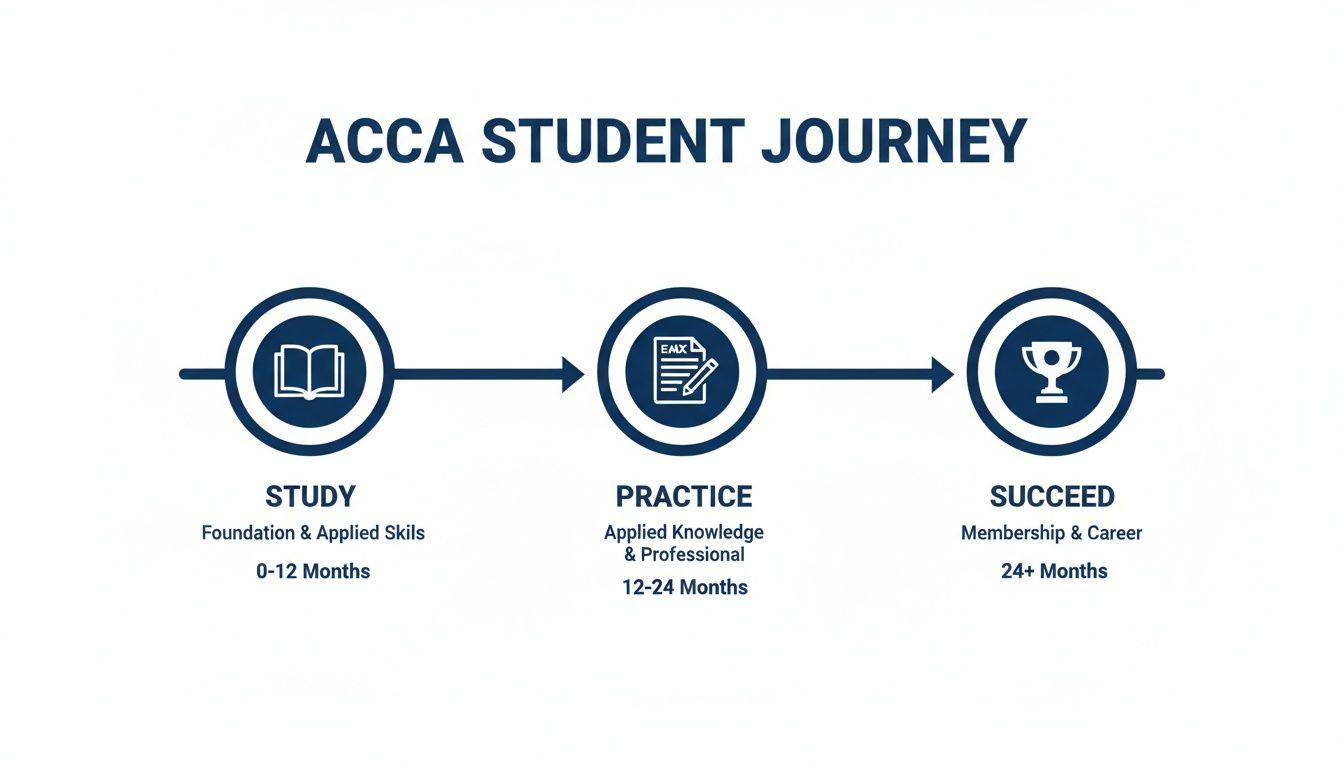
Here's how you can put this phased approach into practice with a clear, strategic timeline.
Your Phased Mock Test Timeline
This table breaks down how to integrate mocks into your final weeks of study, ensuring you build both knowledge and exam-day resilience step by step.
| Phase | Timing (Before Exam) | Objective | Mock Test Condition |
|---|---|---|---|
| Familiarisation | 6 Weeks Out | Understand question styles and syllabus depth. | Untimed, open-book. |
| Partial Simulation | 4-5 Weeks Out | Build speed and manage time in sections. | Timed sections (e.g., only Section A). |
| Full Simulation | 2-3 Weeks Out | Perfect time management and build stamina. | Strictly timed, closed-book. |
By following this structure, you're not just testing what you know; you're systematically preparing for the psychological demands of the exam.
Creating an Authentic Exam Environment
To get the real benefit from a full mock, you need to ditch your comfy study setup. The goal is to train your brain to perform under pressure, a core principle we instil in the 10,000+ students we've trained.
Creating an authentic exam environment for your mock tests is non-negotiable. It trains your brain to associate focus and high performance with a specific set of conditions, making it easier to activate that same state of mind on the actual exam day.
Use this checklist to create your "exam bubble" at home:
- Zero distractions: Let your family know you're unavailable. Turn your phone off (not just on silent!) and close every other tab on your computer.
- Permitted materials only: Have nothing on your desk but your approved calculator, a drink, and your rough paper or the digital scratchpad.
- Stick to the clock: Set a timer for the exact exam duration. No pausing, no extra breaks. The discipline starts here.
This isn't just about answering questions; it's about building the mental endurance the ACCA exam demands. When you master your timeline and your environment, you'll walk into the exam hall feeling prepared, not panicked.
To align your mock strategy with what each paper demands, check out our detailed ACCA syllabus breakdown.
Simulating Real Exam Conditions to Conquer Pressure
In the ACCA exam, your biggest opponent isn't always the complex questions—it's the clock. Just knowing the syllabus inside and out isn't enough. You have to perform calmly and efficiently when the pressure is on. This is where simulating the real exam environment during your ACCA mock tests becomes an absolute game-changer, helping you build resilience and walk into the exam hall with confidence.
The shift to Computer-Based Exams (CBEs) added a new layer of challenge. Navigating the software, using the digital scratchpad, and managing everything on-screen can feel awkward at first. That's precisely why getting hands-on with the official ACCA Practice Platform is non-negotiable. It’s the best way to familiarise yourself with the interface you'll be using on the big day, turning a potential source of stress into just another workspace.
Mastering the CBE Interface
Getting comfortable with the CBE layout is all about building muscle memory. The last thing you want is to waste precious minutes on exam day figuring out how to flag a question or find the calculator. Your mocks need to be done on a platform that mirrors the real thing as closely as possible.
This practice is even more critical when you consider the on-the-ground realities. Exam centres in India, for example, can present unique challenges. Overcrowding, technical glitches, and other disruptions can cause massive stress and delays.
The good news is that students who regularly use the ACCA Practice Platform for their mocks become so familiar with the interface that they are far less rattled by disruptions. They have built the confidence and muscle memory to stay focused on the task at hand. You can get more insights on handling ACCA exam centre challenges in India on finplanindia.com.
Practical Tips for a Flawless Simulation
Creating a genuine exam environment isn’t just about sitting at a desk; it's a discipline. It’s about training your mind and body to drop into a state of deep focus whenever you need it. Here’s how you do it:
- Eliminate All Distractions: Let your family know you're off-limits for the next three hours. Turn your phone off—don't just silence it—and put it in another room. Close every other tab on your computer.
- Use Only Permitted Tools: Your desk should be clear except for your approved calculator and a glass of water. Get used to using the on-screen scratchpad for all your workings. This is a crucial CBE skill.
- Adhere to Strict Timings: Set a timer and be ruthless about it. No pauses, no "just one more minute." Building this discipline is a core part of your training.
This rigorous approach is something our Chief Tutor, Mr. Padmanaban, instils in every student. Having guided over 10,000 students to success with his founder-led expertise, he knows that strategic preparation always wins over simple memorisation.
The purpose of a simulated mock isn't just to test what you know, but to condition how you react to pressure. When the real exam feels just like another practice run, you've already won half the battle.
On-the-Go Practice for Working Professionals
If you’re a working professional in the Gulf or India, finding an uninterrupted three-hour block to practice can feel impossible. This is exactly why our "Study Anytime/Anywhere" ecosystem is so powerful.
Our Mobile App is designed to turn every spare moment into a productive study session. While you still need dedicated time for a full simulation, you can sharpen your skills constantly by tackling questions on the go.
The app gives you access to:
- Over 300+ lecture hours for a quick refresher whenever you need it.
- More than 4000+ MCQs to drill down on specific topics.
- Over 1500+ solved problems to walk you through tricky concepts.
By using the app during your commute in Dubai or on a lunch break in Mumbai, you continuously reinforce what you’ve learned. This flexible approach means that even with a packed schedule, you're always preparing, making those full mock test sessions even more effective when you finally sit down for them.
Analysing Your Performance Like an Expert
Finishing your ACCA mock test is just the halfway point. The real learning, the part that actually gets you closer to a pass and achieves genuine concept clarity, starts the moment you put your pen down.
A lot of students just glance at their score and move on. Honestly, that’s one of the biggest mistakes you can make. The true value of a mock isn't the score itself—it's the detailed analysis that comes after. This is where you turn raw data into a powerful, personalised study plan.

This mentor-led approach, something our Chief Tutor Mr. Padmanaban drills into every student, is about digging deeper. It’s not just about what you got wrong, but why. This deeper level of self-awareness is what separates a pass from a fail and it’s a core principle we’ve instilled in the 10,000+ students we’ve successfully trained.
A Framework for Understanding Your Mistakes
You can't fix a problem if you don't know what's causing it. Every single incorrect answer can be traced back to a specific type of error. When you start categorising your mistakes, you can build a hyper-targeted revision plan that tackles the root cause, instead of just re-reading the whole syllabus and hoping for the best.
So, grab a notebook or open a spreadsheet. For every question you got wrong or had to guess, assign it to one of these four categories:
Conceptual Gaps: This is the most fundamental error. You simply didn't know the rule, the formula, or the underlying principle needed to answer the question. You were lost from the start.
Application Errors: You actually knew the concept, but you couldn't apply it correctly to the scenario. Maybe you used the right formula but plugged in the wrong numbers, or you completely misinterpreted what the examiner was asking.
Time Management Failures: This one hurts. You knew the answer and how to get there, but you either rushed and made a silly mistake or just ran out of time. It often means you spent too long on earlier, low-mark questions.
Careless Slips: The most frustrating of all! These are the simple calculation mistakes, reading "not" as "now," or copying a number wrong from your scratchpad. They have nothing to do with knowledge and everything to do with focus.
This kind of structured debrief takes you from feeling overwhelmed by a low score to having a clear, actionable list of things to work on.
Drilling Down with Targeted Practice
Once your mistakes are neatly categorised, your path forward becomes crystal clear.
For instance, if your log is full of "Conceptual Gaps," it’s a signal to go back to the source material. This is where our "Study Anytime/Anywhere" ecosystem becomes your best friend. The Stride Edutech Mobile App gives you access to over 300+ lecture hours, letting you instantly replay the exact class where Mr. Padmanaban breaks down a tough concept. If you're a student in the Gulf, this means you can review a tricky IFRS standard on your commute in Dubai without waiting for the next live class.
"A mock test result isn't a final grade; it's a diagnostic report. It tells you precisely which areas need your attention. Your job is to listen to that feedback and act on it with precision."
But what if your main issue was "Application Errors"? That means you need more question practice, period. The app is loaded with a massive question bank to help with exactly that:
- 4000+ MCQs to sharpen your speed and accuracy.
- 1500+ solved problems that walk you through the correct application, step-by-step.
For working professionals in India or the UAE, this is a game-changer. You can use those small pockets of free time to drill down on the specific question types you struggled with in the mock. Instead of passively reading, you’re actively solving problems and building the muscle memory you'll need on exam day.
This approach transforms every spare minute into a high-impact study session—and that’s everything when you’re balancing a job with studies on your ACCA journey. The analysis of your mock isn't just a review; it's the blueprint for your final, crucial weeks of preparation.
Turning Your Mock Results Into a Killer Revision Plan
A generic revision plan gets you average results. But a plan built from the hard data in your ACCA mock test? That’s what leads to exceptional performance. The analysis you just did is your new roadmap. It’s time to stop studying everything and start focusing on what will actually get you marks.
This is how you turn the final weeks of study into a high-impact campaign to secure a pass. It's about allocating your remaining time with surgical precision, hitting the high-weightage topics where your mock showed weakness. This active, data-led approach is the cornerstone of the mentorship our Chief Tutor, Mr. Padmanaban, has used to guide over 10,000 students to exam success.
Building Your Data-Driven Study Schedule
First things first, grab that list of errors you categorised and map it against the ACCA syllabus weightings for your paper. This creates a simple but powerful priority list. Let's be honest, a conceptual gap in a topic worth 25 marks is a much bigger fire to put out than a careless slip in a 5-mark question.
Your weekly schedule should look completely different now. Forget about giving equal time to all chapters. It's time to focus your energy where it will make the biggest difference.
- High-Priority (60% of your time): This is for your non-negotiables. Hammer away at conceptual gaps and application errors in high-weightage syllabus areas.
- Medium-Priority (30% of your time): Use this time to tackle application errors in medium-weightage topics and sort out any time management issues on those tricky question types.
- Low-Priority (10% of your time): Quickly review topics where you made silly mistakes. A few practice questions here should be enough to sharpen your focus.
This structure forces you to actively fix the problems most likely to cost you marks on exam day, rather than just passively re-reading stuff you already know. If you're struggling to find the right resources for these weak spots, check out our guide on the best ACCA study materials and books.
Active Recall is the Key to Real Learning
Let’s get one thing straight: simply re-reading your notes is not revision. It’s one of the least effective ways to learn. Your brain needs to be actively pulling out and applying information. That's how shaky knowledge becomes solid, exam-ready competence.
Try weaving these active recall techniques into your new schedule:
- Re-do Incorrect Questions: Wait a week after your mock, then try every question you got wrong again. No peeking at the answer! This forces your brain to actually work through the problem-solving process from scratch.
- Create Topic Mind Maps: For concepts that tripped you up, try creating a one-page mind map from memory. It’s a great visual way to connect different parts of a topic and instantly see where the gaps are.
- Practice Similar Problems: Jump into a question bank and find problems related to your specific weak areas. Repetition is what builds mastery and, just as importantly, confidence.
This targeted approach, focused on achieving deep concept clarity, has a proven impact on exam success. Mock debriefs are fantastic for pinpointing specific weaknesses and fixing those critical knowledge gaps before the real exam.
"Your mock test results are not a judgment—they are a guide. They give you the incredible advantage of knowing exactly where to direct your efforts in the final stretch. Use that advantage wisely."
The Ultimate Tool for Targeted Revision
This is where our "Study Anytime/Anywhere" ecosystem really comes into its own, especially for busy working professionals in India and the Gulf. Your revision plan might tell you that you need to brush up on IFRS 15, but finding the time is the real challenge.
With the Stride Edutech Mobile App, the solution is right in your pocket. Instead of waiting for a live class, you can instantly pull up the exact lecture where our Chief Tutor, Mr. Padmanaban, breaks down that standard with his founder-led expertise.
- Access 300+ lecture hours to revisit any topic whenever you need to.
- Drill down with 4000+ MCQs to practice questions on your weak areas.
- Walk through 1500+ solved problems to see exactly how it’s done.
This immediate access means you can act on the insights from your ACCA mock test instantly. It turns a moment of weakness into an opportunity for growth, no matter where you are or what your schedule looks like.
Got Questions About ACCA Mocks? We Have Answers.
As you start weaving the ACCA mock test into your study routine, it's completely normal for questions and doubts to pop up. Feeling a bit uncertain is part of the process, but getting clear, expert-backed answers can turn that anxiety into confident action.
This is where we step in. We've gathered the most common questions we hear from students across India and the Gulf. Drawing on the mentorship philosophy of our Chief Tutor, Mr. Padmanaban, who has guided over 10,000 students to success, we’ll give you the clarity you need to nail your mock test strategy and walk into your exam feeling ready for anything.
How Many Mock Tests Should I Actually Take?
The golden rule here is simple: quality over quantity. Your target should be at least three full-length mock exams, taken under strict, timed conditions in the final weeks before your real exam.
Think of it like this:
- Mock 1: The Diagnostic. Your first attempt is all about getting a baseline. Where are you right now? This mock will shine a light on the major weak spots across the syllabus.
- Mock 2: The Progress Check. Take this one a week or two after the first. It’s designed to show you if your targeted revision is paying off and helps you fine-tune your game plan.
- Mock 3: The Final Dress Rehearsal. This is your last practice run, ideally about a week before the exam. It’s all about confirming you’re ready, perfecting your time management, and building that final surge of confidence.
What Should I Do If I Score Badly?
First off, don't panic. A low score on a mock test is not a sign of failure—it's incredibly valuable data. The absolute worst thing you can do is let it demotivate you. The best thing? Get analytical.
A disappointing score is just a spotlight showing you exactly where to focus your remaining study time for the biggest impact.
Instead of feeling defeated, jump straight into the debriefing process we talked about earlier. Go through every single error and categorise it. Was it a gap in your understanding of a concept? A mistake in applying the knowledge? Or did you just run out of time? A poor mock score gives you a chance to fix critical problems before they count on exam day.
"A low mock score is a gift. It reveals your weaknesses when the stakes are low, giving you a clear and urgent mission for your final revision."
Should I Use Official ACCA Mocks or Third-Party Ones?
The smartest strategy is to use both. Each type serves a distinct and vital purpose in your preparation journey.
- Official ACCA Mocks: These are non-negotiable. Using the ACCA Practice Platform is the only way to get completely comfortable with the real exam interface, how questions are presented, and all its functionalities. Mastering the CBE environment is essential, and this is how you do it.
- High-Quality Third-Party Mocks: Resources like ours at Stride Edutech can offer a wider variety of questions and scenarios. This helps you build a more robust and flexible understanding of the topics, preparing you for any curveballs the examiner might throw your way.
How Can I Get Faster and Manage My Time Better?
Time management isn't a talent you're born with; it's a skill you build through deliberate practice. The key is to be methodical.
During your mock review, calculate the average time you spent per mark. Pinpoint which specific question types consistently slow you down. Are you getting bogged down in narrative questions? Do MCQs take you too long?
This is where targeted practice becomes your secret weapon. Our Mobile App is designed perfectly for this kind of focused training. For working professionals in the UAE or India, you can use short breaks to drill down on those problem areas. With over 4000+ MCQs, you can turn every spare ten minutes into a high-intensity session to boost your speed and accuracy. It’s a "Study Anytime/Anywhere" ecosystem that ensures your preparation never has to hit pause.
At Stride Edutech, we are committed to giving you the tools, mentorship, and flexibility you need to hit your ACCA goals. Our founder-led expertise means you get guidance from Mr. Padmanaban with over 30+ years of experience at every step. Having trained 10,000+ students, we know what it takes to achieve exam success. Discover how our courses and powerful Mobile App can support your journey at https://strideedutech.com.