

You’ve decided to pursue an ACCA qualification—a powerful step towards a prestigious global career. But let's be honest, the path can seem complex. This guide is designed to cut through that complexity, offering a clear, mentor-led roadmap for ambitious students and working professionals in India and the Gulf, focused on achieving exam success through genuine concept clarity.
Your Roadmap to a Global ACCA Qualification
Embarking on the ACCA journey is a serious commitment to professional excellence, one that opens doors to opportunities in over 180 countries. For many in India and the Gulf, the question isn’t why you should do it, but how to even start and stay on track while juggling a demanding schedule. This roadmap is designed to give you that exact clarity and confidence.
This is more than just a guide; think of it as a partnership for your entire journey. Our approach is built on the founder-led expertise of our Chief Tutor, Mr. Padmanaban, who brings over 30 years of experience to personally mentor every student. His philosophy is simple: focus on deep concept clarity to guarantee exam success. It’s a method that has already helped over 10,000+ students achieve their goals.
Our Framework for Your Success
We understand the unique challenges you face, especially as a working professional. Balancing a full-time job, particularly with the demanding work culture in the Gulf, requires a learning system that’s both flexible and structured. Our entire model is built to support you.
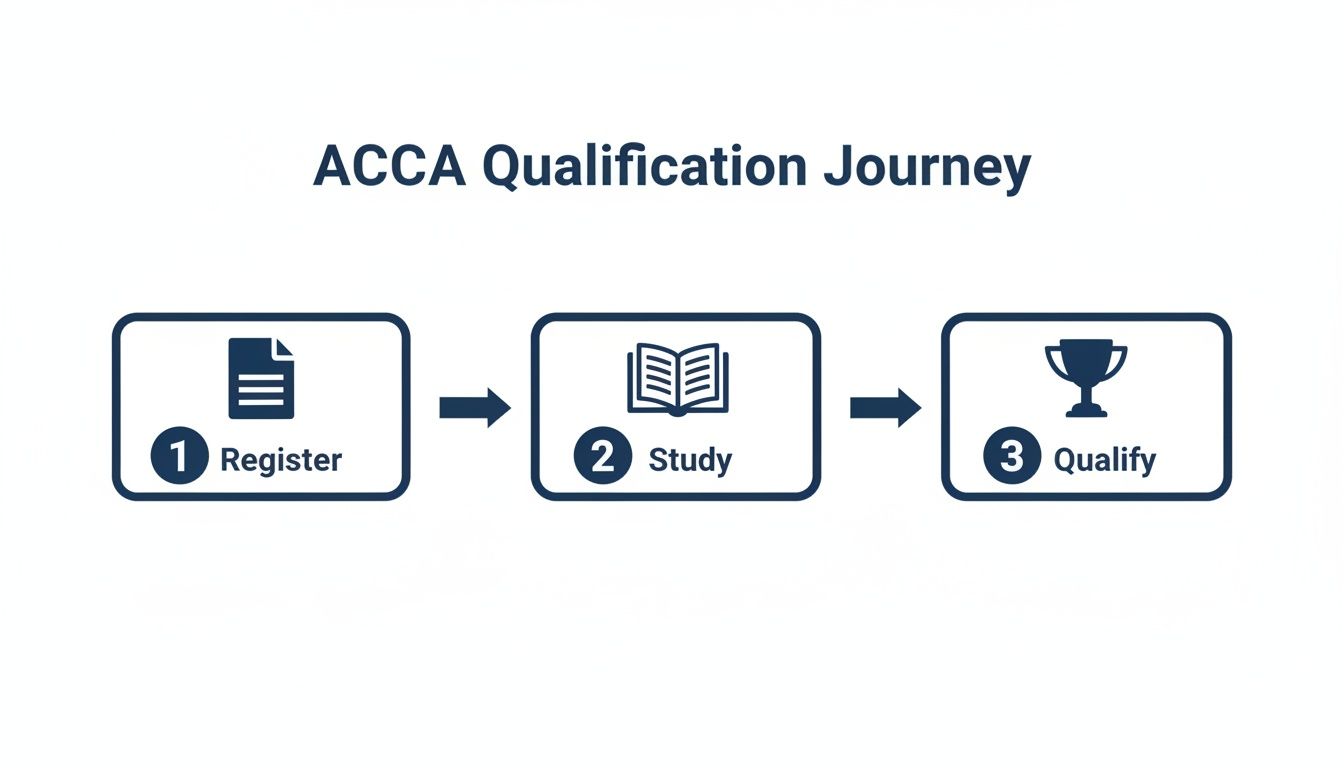
At its core, becoming ACCA qualified is a three-stage process: you register with ACCA, you study and pass the exams, and you fulfil the practical experience requirements to qualify as a member. Our goal is to provide the expert support you need at every single stage.
The journey is straightforward when you break it down, as the infographic below shows.
A key pillar of our support is the “Study Anytime/Anywhere” ecosystem, powered by our dedicated Mobile App. For students in the UAE, Saudi Arabia, or Qatar, this is a game-changer. Daily class recordings are uploaded directly to the app, so you can catch up on lectures at your own convenience, no matter the time zone or your work shift.
This powerful tool includes:
- 300+ lecture hours
- 4000+ Multiple Choice Questions (MCQs)
- 1500+ solved problems
The Mobile App is completely free for all our enrolled students, giving you a proven framework for success from day one. It is also available for separate purchase.
Decoding Your ACCA Eligibility and Exemptions

Before you buy books or book your first exam, let's establish your starting point. The path to becoming ACCA qualified begins with two key questions: are you eligible, and can you skip some exams? This is where exemptions come in, and for many aspiring accountants in India and the Gulf, they are a game-changer.
Think of exemptions as ACCA's way of crediting you for what you already know. Based on your previous qualifications, you can bypass certain papers, saving significant time and money. Starting your ACCA journey without checking for exemptions is like leaving a valuable advantage on the table.
Who Can Start The ACCA Journey?
One of ACCA's greatest strengths is its accessibility. There are several entry points, ensuring a clear path for you regardless of your academic background.
Your starting point depends on your education:
- Foundations in Accountancy: If you haven't completed your 10+2 or don't meet the requirements for the main qualification, this is your ideal start. It builds the core knowledge needed for future success.
- The ACCA Qualification: To jump straight in, you’ll typically need to have passed your 10+2 exams with passes in at least five subjects, including English and Mathematics. Most university degrees and other professional certifications also grant direct entry.
For most working professionals and graduates, your existing degree almost certainly makes you eligible to start the main qualification directly. The real work is finding out which papers you don't have to sit for.
The Power of Exemptions for Professionals
This is where your strategy truly begins. Are you a B.Com graduate from an Indian university? A CA-IPCC holder? Do you have a finance degree from a university in the UAE or Saudi Arabia? If so, you are almost definitely eligible for exemptions.
The goal isn’t just to get started; it’s to start smart. Claiming your exemptions correctly can let you skip up to nine papers—that can save you over a year of study time and thousands in fees. It’s the single most effective way to fast-track your qualification.
The first thing you should do is use ACCA's official exemptions calculator. It’s a fantastic tool where you input your qualification and institution to see which papers you might skip. We make this a priority for every student, ensuring no one misses out on the credit they’ve earned.
The table below gives you a quick idea of what’s possible for some common qualifications in India and the Middle East.
Potential ACCA Exemptions for Common Qualifications
| Your Qualification | Potential ACCA Exemptions (up to) | Relevant ACCA Level |
|---|---|---|
| B.Com/BBA (from a recognised university) | Up to 6 papers | Applied Knowledge & Applied Skills |
| CA Intermediate/IPCC | Up to 6 papers | Applied Knowledge & Applied Skills |
| Indian Chartered Accountant (CA) | 9 papers | All Applied Knowledge & Applied Skills |
| MBA in Finance | Varies (up to 4-5 papers) | Applied Knowledge & Applied Skills |
| Master of Commerce (M.Com) | Varies (up to 7 papers) | Applied Knowledge & Applied Skills |
| UAE/Gulf B.Com or BBA | Varies (up to 4-5 papers) | Applied Knowledge & Applied Skills |
As you can see, your past studies can give you a significant head start, allowing you to focus your energy on the more advanced, strategic-level papers.
Our founder, Mr. Padmanaban, has personally guided thousands of students through this exact process over his 30+ years of mentorship. His experience with working professionals is invaluable, helping them build on what they already know without wasting time re-studying old topics. This focus on concept clarity has been a pillar of success for over 10,000+ students.
The paperwork can be a headache, but we’re here to ensure you get it right the first time. For a detailed breakdown, you can learn more about ACCA exemptions and what they mean for you.
This flexibility means you can immediately dive into the material that's new to you, supported by our “Study Anytime/Anywhere” ecosystem and our powerful Mobile App. For enrolled students, the app is a treasure trove of resources, including:
- Over 300+ lecture hours of expert lectures
- More than 4000+ MCQs for practice
- A library of 1500+ solved problems
With these tools at your fingertips, you can be confident that you’re focusing your efforts where they'll have the biggest impact.
Understanding the ACCA Exam Structure
To conquer the ACCA, you first need a map. The qualification is broken down into three logical levels, designed to take you from a foundational understanding of business to the strategic thinking of a finance leader. It’s a journey, not a sprint.
This isn’t about cramming formulas; it’s about achieving real concept clarity. This is where having an experienced guide is crucial. All our courses are personally mentored by our Chief Tutor, Mr. Padmanaban. With his 30+ years of experience, he ensures every student gets consistent, high-quality teaching focused on the core concepts that lead to exam success.
The Three Levels of ACCA Exams
The ACCA qualification has 13 papers in total, split across three modules. Think of it like this: first, you lay the foundation, then you build the core structure, and finally, you add the expert, specialised finishes.
- Applied Knowledge: This is where it all starts, giving you a solid introduction to finance and accounting.
- Applied Skills: This level builds on that foundation, providing the robust, practical skills that employers seek.
- Strategic Professional: The final level, where you develop the strategic vision and ethical judgment to become a leader in any organisation.
This step-by-step progression builds your confidence and skills with every paper you clear. Let's look at what's inside each level.
A Closer Look at Applied Knowledge
The Applied Knowledge level is your starting block, made up of three papers that introduce you to finance and accounting.
These exams are on-demand Computer-Based Exams (CBEs). The best part? You can take them at any time of the year at an approved centre. This flexibility is a huge advantage, especially for working professionals trying to fit exams around a tough work schedule.
The three papers are:
- Business and Technology (BT): Teaches you how businesses work and the role finance plays in them.
- Management Accounting (MA): You’ll get to grips with the basics of costing, budgeting, and managing performance.
- Financial Accounting (FA): Covers the core principles of preparing financial statements.
Getting these first three papers right is non-negotiable—they set the stage for everything that comes after. Under Mr. Padmanaban's mentorship, we ensure you don't just pass but truly master the concepts. This is what will carry you through the tougher Applied Skills papers.
Advancing to the Applied Skills Level
After clearing the Applied Knowledge papers (or getting exemptions), you’ll move on to Applied Skills. This module is where things get more technical, with six papers designed to deepen your practical knowledge.
The exams here are session-based CBEs, a mix of objective questions and longer case-study style problems. This means you can only sit for them during the four official exam windows each year: March, June, September, and December.
For professionals in India and the Gulf, this is often where the real juggling act between work and study begins. To help with this, we created our “Study Anytime/Anywhere” ecosystem. If you miss a live class because of a late shift in Dubai or a tight deadline in Mumbai, no problem. Daily class recordings are uploaded to our Mobile App so you can catch up whenever you want.
Our powerful Mobile App, free for all our students, is like having a personal tutor in your pocket. It’s loaded with:
- Over 300+ lecture hours covering the full syllabus.
- More than 4000+ MCQs to drill and test your knowledge.
- A huge library of 1500+ solved problems for in-depth practice.
Reaching the Strategic Professional Level
This is the final hurdle. The Strategic Professional level is split into Essentials (both are compulsory) and Options (you choose two out of four).
- Essentials: These are Strategic Business Leader (SBL) and Strategic Business Reporting (SBR). They are designed to give you the strategic mindset and reporting skills that senior finance roles demand.
- Options: Here, you specialise. Choose two from Advanced Financial Management (AFM), Advanced Performance Management (APM), Advanced Taxation (ATX), or Advanced Audit and Assurance (AAA), depending on your career goals.
These final papers are where the guidance of a seasoned expert like Mr. Padmanaban makes all the difference. He helps you break down complex case studies and build the critical thinking needed to excel. Our track record of helping over 10,000+ students succeed is a testament to this focused, mentorship-driven approach.
Building Your ACCA Study Plan: A Realistic Guide
Knowing the ACCA exam structure is one thing; conquering it is another. From my experience mentoring students, the single biggest hurdle isn't the difficulty of the papers—it's time management. A solid study plan is the bridge between your ACCA ambition and your qualification.
But let's be realistic. There’s no one-size-fits-all plan. The right approach for a full-time student is completely different from what a working professional in Mumbai or an accountant with a hectic project in Dubai can manage.
The key is finding a rhythm that is both ambitious and sustainable. Going too hard, too fast is a recipe for burnout. But a plan that's too relaxed won't build the momentum you need for exam success. You need a sweet spot that allows for deep concept clarity without sacrificing your job or your sanity.
Choosing Your Study Pace
The ACCA qualification is designed to be flexible. You can finish it in as little as 18 months or take up to ten years. Most people, especially working professionals, land somewhere in the middle.
The Fast-Track (18-24 Months) plan is intense. It's built for full-time students or incredibly disciplined professionals who can carve out serious study time each week. This usually means tackling two or more papers every exam session.
On the other hand, the Balanced Pace (30-36 Months) is a much more manageable route for most working professionals. By focusing on one paper per session, you give yourself enough time to truly master the material without feeling overwhelmed. This steady, consistent approach is often the most effective path to success.
The best plan isn't the fastest one—it's the one you can actually stick to. Consistency beats intensity every single time. Be honest with yourself about your commitments and choose a timeline that protects your well-being while leaving enough room for proper revision.
Sample ACCA Study Timelines
Seeing how different timelines stack up can help you decide which path makes the most sense. A full-time student has a very different reality from someone balancing a 50-hour work week.
This table breaks down the two most common approaches to help you choose wisely.
| Timeline | Best For | Average Papers Per Session | Key Consideration |
|---|---|---|---|
| 18-Month Fast-Track | Full-time students, highly disciplined professionals with few other commitments. | 2-3 papers | Requires a rigorous schedule; high risk of burnout if not managed carefully. |
| 3-Year Balanced Pace | Most working professionals, especially in demanding roles in India or the Gulf. | 1 paper | Allows for deep learning and revision, making it easier to balance work, life, and studies. |
Ultimately, the most successful students I've mentored are those who build their study schedule around their non-negotiable commitments, like work shifts and family time. They learn to use small pockets of time—the morning commute, a lunch break—to their full advantage.
The Ultimate Advantage for Working Professionals
For professionals in India and especially the Gulf, the main challenge is juggling demanding jobs with study. Late shifts in Dubai, unpredictable project deadlines in Saudi Arabia, and different time zones can make attending fixed live classes almost impossible. This is precisely why we created our "Study Anytime/Anywhere" ecosystem.
It’s a game-changer. All our classes, personally mentored by our Chief Tutor Mr. Padmanaban, are recorded daily. These recordings are uploaded to the Mobile App almost immediately. You never have to stress about missing a lecture again. You can catch up on your commute, during a break, or late at night—whenever it fits your schedule. This flexibility lets you learn from a mentor with 30+ years of experience without being chained to a rigid timetable.
This model puts you in total control. With our powerful Mobile App, you can turn your daily commute on the Dubai Metro or a quiet evening in your Riyadh apartment into a productive revision session. The app is a complete study toolkit, giving you:
- 300+ lecture hours for on-demand learning.
- 4000+ MCQs to test your knowledge on the go.
- 1500+ solved problems to cement your understanding of complex topics.
The Mobile App is free for all our enrolled students and has been a cornerstone in the success of the 10,000+ students we've trained. To see how this flexible learning model can fit into your life, discover more about our online ACCA courses designed for students in India and the Gulf. This freedom is how you turn a challenging journey into an achievable one.
Fulfilling Your Experience and Ethics Requirements
Passing your exams is a huge milestone, but it’s only half the story. The ACCA qualification is built on two pillars: theory (what you know) and practice (what you can do). To connect the two, ACCA requires every student to complete the Practical Experience Requirement (PER) and the Ethics and Professional Skills Module (EPSM).
Think of this as the final leg of your journey, where you prove you can apply your knowledge in a real-world business environment. It’s what transforms you from an exam-passer into a qualified, trusted finance professional.
Our approach, which has guided over 10,000+ students to success, goes beyond just exam prep. We ensure you’re ready for this practical stage, so your PER feels like a natural extension of your studies, not another mountain to climb.
Understanding the Practical Experience Requirement (PER)
The PER is your opportunity to show ACCA that you can perform in a professional workplace. To meet this requirement, you’ll need to log 36 months of relevant work experience and achieve a set of performance objectives.
The best part? You don’t have to wait until your exams are over. You can start logging your experience the moment you register as an ACCA student. For working professionals in India and the Gulf, this is a massive advantage—the job you have right now could already be counting towards your PER.
A common question is, "What counts as relevant experience?" It’s more flexible than you might think. Your role just needs to give you experience in at least one technical area, like:
- Financial Reporting
- Audit and Assurance
- Taxation
- Management Accounting
- Finance
You'll track all your progress in ACCA's online "MyExperience" portal under the guidance of a PER supervisor—usually your line manager or another qualified professional who can sign off on your work.
Mastering the Ethics and Professional Skills Module (EPSM)
The EPSM is an interactive online module that teaches you the professional skills that employers value most. It covers everything from communication and commercial savvy to professional scepticism and self-management, all tied together with a strong ethical backbone.
Completing the EPSM isn't just about getting a certificate; it’s a career-defining step. The principles you learn here are what separate a good accountant from a great one. It gives you the professional judgement to handle complex, messy situations with integrity.
This is where the deep concept clarity you gain from our teaching style really shines. The mentorship from our Chief Tutor, Mr. Padmanaban, isn't just about passing exams. With over 30+ years of experience, he teaches the "why" behind the rules, which directly prepares you to apply ethical principles on the job.
The module is designed to be tackled once you reach the Strategic Professional level, as the content syncs perfectly with what you’ll be learning in your final papers.
Your Support System for PER and EPSM
We know that balancing a full-time job while logging your PER and finishing the EPSM can be tough, especially for our students in the Gulf with demanding schedules. Our entire learning model is built to support you beyond the classroom.
Our "Study Anytime/Anywhere" ecosystem gives you the flexibility to juggle all your commitments. Through the Mobile App, you can access lectures and resources whenever it works for you. This means you can focus on gaining practical experience at work and use your own time to study without falling behind.
The app is loaded with resources that strengthen your technical skills, which in turn helps you meet your PER objectives:
- Over 300+ lecture hours covering the entire syllabus.
- A question bank of 4000+ MCQs to sharpen your technical knowledge.
- 1500+ solved problems that show you how concepts are applied in the real world.
This powerful mix of expert mentorship from Mr. Padmanaban and unmatched flexibility through our Mobile App ensures you’re not just prepared for exams, but for a successful and ethical career as an ACCA member.
Crossing the Finish Line: Fees, Results, and Next Steps
You’re almost there. The exams are tough, but you’ve made it to the final stage of your ACCA journey. This is where you cross the finish line by managing the last few practical steps—booking exams, handling fees, and getting your results—before officially becoming an ACCA member.
This final push is where your preparation and our support system really come together. The deep concept clarity you’ve gained from our Chief Tutor, Mr. Padmanaban, and his 30+ years of experience is your biggest advantage now. You’re more prepared than you think.
Managing Your ACCA Fees and Exam Bookings
Let's talk about the money side of things. You'll need to budget for a few different ACCA fees: initial registration, annual subscription, exam fees, and any exemption fees. Planning for these costs upfront means you can focus entirely on studying, not on last-minute financial surprises.
Booking your exams happens through the myACCA portal. The trick is to book early, especially for session-based CBEs (Computer-Based Exams), to lock in your preferred exam centre and time slot. For our students in India and the Gulf, planning around busy work seasons or public holidays is key to a hassle-free experience.
The real value of an ACCA membership isn't just a line on your CV; it's the global recognition and career mobility it provides. The investment you make now pays dividends for your entire professional life, opening doors in India, the Gulf, and worldwide.
Interpreting Your Results and Moving Forward
After all that hard work, the big day arrives. Exam results are released on a specific date, and you’ll get an email prompting you to check your scores on the myACCA portal. If you’ve passed, fantastic! It’s time to celebrate and then plan for your next paper.
But what if you don't get the score you wanted? Remember, it's a setback, not a full stop. This is where good mentorship makes all the difference. We will help you analyse your performance, pinpoint where things went wrong, and build a smart revision plan to tackle it again.
This is where our advantage truly kicks in. Our Mobile App, with its huge library of over 1500+ solved problems and 4000+ MCQs, becomes your best friend for rebuilding confidence. With our flexible "Study Anytime/Anywhere" ecosystem, you can jump straight back into revision using recorded lectures. It's how over 10,000+ students have overcome their own hurdles to achieve exam success. You’ve got this, and our community is right here to back you up.
Your Questions About the ACCA Journey, Answered
As you map out your path to becoming an ACCA, it’s natural to have questions. We hear them all the time from students in India and the Gulf. Here are some of the most common queries we get, with straightforward answers from our experience.
Can I Study for ACCA While Working Full-Time?
Yes, you absolutely can. In fact, most of our students are working professionals, many with demanding jobs in the Gulf countries like the UAE, Saudi Arabia, Oman, Kuwait, Qatar, and Bahrain. We’ve built our entire coaching model around this reality.
Our “Study Anytime/Anywhere” ecosystem is powered by our Mobile App. Every class recording is uploaded daily, so you can catch up on your commute, during a lunch break, or late at night. This flexibility ensures you get the full benefit of our Chief Tutor Mr. Padmanaban’s guidance, no matter your work shift or time zone.
What Is the Difference Between ACCA and CA in India?
Both are top-tier qualifications, but they’re built for different career paths. The Indian CA focuses heavily on Indian laws, domestic accounting standards, and local taxation. It’s the perfect choice if your career ambitions are firmly within India.
ACCA, however, is your passport to the world. It’s a globally recognised qualification that opens doors in over 180 countries. If you dream of an international career or want the flexibility to work anywhere from Dubai to London, ACCA is the way to go.
What If I Fail an ACCA Exam?
First off, don't panic. An exam setback isn’t a dead end; it's a chance to reassess and come back stronger. This is where our mentor-led support really shines. With over 30+ years of experience, our founder Mr. Padmanaban personally mentors students to analyse their results, pinpoint where they went wrong, and help them rebuild their concept clarity.
An exam setback is simply a redirection. With the right guidance and resources, you can turn a failed attempt into the foundation for an even stronger pass next time.
Our Mobile App becomes your best friend here. It’s packed with resources to help you prepare for a retake with confidence, including:
- 4000+ practice MCQs
- 1500+ solved problems
This dedicated support system is a key reason why over 10,000+ students we’ve trained have found exam success. You have all the tools you need to overcome any hurdle.
Your journey to becoming a globally recognised finance professional starts with a single, confident step. At Stride Edutech, we provide the mentorship, flexibility, and resources you need to succeed. Explore our ACCA courses today and join a community dedicated to your success.