
The ACCA vs. CPA debate. It’s one of the biggest questions we see from aspiring finance professionals in India and the Gulf. Both are powerhouse qualifications, but they open very different doors. The choice you make isn't just about exams; it's about defining your entire career path for years to come. This guide, led by the expertise of our mentors, is designed to bring you absolute clarity for your journey.
So, how do you decide? It all boils down to one simple question: Where do you want your career to take you?
If you dream of a global career with flexibility, ACCA is your passport. It has massive recognition in over 180+ countries, making it a top choice for roles in the UK, Europe, the Middle East, and with multinational corporations (MNCs) everywhere. On the other hand, if your ambitions are tied to the United States, the CPA is the undisputed gold standard. This makes it essential for roles in US-based firms and the rapidly expanding Global Capability Centres (GCCs) right here in India.
Choosing Your Path: ACCA vs CPA for Students & Professionals
Committing to a professional qualification is a huge step, and making the right choice between the Association of Chartered Certified Accountants (ACCA) and the Certified Public Accountant (CPA) can feel overwhelming. This guide is here to cut through the noise, providing authoritative insights so you can move forward with confidence and achieve exam success.
Our goal isn’t to crown a "winner." Instead, we're here to give you a detailed, balanced acca vs cpa comparison based on our Founder-Led Expertise. We’ll look at everything from regional demand and career goals to the practical details of getting qualified, ensuring every insight is actionable for your journey, especially if you are a working professional balancing a job with studies.
A Quick Comparison
To get started, let's break down the core differences. Think of this table as your high-level cheat sheet.
| Attribute | ACCA (Association of Chartered Certified Accountants) | CPA (Certified Public Accountant – USA) |
|---|---|---|
| Primary Focus | International Financial Reporting Standards (IFRS) | U.S. Generally Accepted Accounting Principles (U.S. GAAP) |
| Global Reach | Recognised in 180+ countries, with a strong presence in the UK, Europe, Gulf, and Asia. | Primarily US-focused, but in high demand at US-based MNCs and GCCs globally. |
| Best For | Careers in Big 4 firms and MNCs in India, and across the entire Gulf region (UAE, Saudi Arabia, Oman, Kuwait, Qatar, Bahrain). | Roles in US companies, especially GCCs in India, and public accounting careers in the US. |
| Exam Structure | 13 papers spread across three flexible levels, with exemptions available. | 4 rigorous sections that must be completed within a strict 18-month window. |
This comparison immediately highlights the fundamental choice: ACCA offers incredible breadth and global mobility, while the CPA delivers deep, specialised expertise for the US market.
Both paths lead to fantastic careers, but the right one for you truly depends on where you want to work and what you want to achieve. For a closer look at the US qualification, you can dive into our detailed guide on the Certified Public Accountant (CPA).
Global Recognition and Regional Career Opportunities
Choosing between ACCA and CPA isn’t just about the exams; it’s a strategic career move. The real value of each qualification depends heavily on where you want to work and what you want to achieve. Any good ACCA vs CPA comparison has to start with geography.
For professionals in India and the Gulf, this is everything. Your choice will directly impact the roles you land, the companies that hire you, and your long-term success. Let's break down what this means in the real world for these key markets.
The ACCA Advantage in India and the Gulf
The ACCA qualification is your passport to a world that runs on International Financial Reporting Standards (IFRS). Since IFRS is the mandatory standard in over 144 countries, including the entire Gulf region (UAE, Saudi Arabia, Oman, Kuwait, Qatar, Bahrain) and for most listed companies in India, ACCA members are always in demand.
- In India: ACCA is a powerhouse qualification, especially for roles in Big 4 firms and multinational corporations (MNCs). Its wide-ranging syllabus covers finance, management, and strategy, making you a perfect fit for jobs like Financial Analyst, Internal Auditor, or Management Accountant in global companies.
- In the Gulf (UAE, Saudi Arabia, Qatar): ACCA is often seen as the gold standard. Thanks to strong mutual recognition agreements and its IFRS alignment, ACCA professionals find great opportunities in banking, real estate, oil and gas, and more.
Our founder, Mr. Padmanaban, draws on his 30+ years of experience to personally mentor students. He ensures you're not just ready to pass exams, but equipped with the deep concept clarity needed to meet the specific demands of employers in India and the Middle East.
The Rise of CPA in Niche Indian Markets
While ACCA gives you broad access, the CPA (USA) offers deep, in-demand expertise. Its laser focus on U.S. Generally Accepted Accounting Principles (U.S. GAAP) and American regulations makes it essential for a very specific—and booming—sector.
The main driver for CPA demand in India is the explosion of US-based Global Capability Centres (GCCs). These offshore hubs, run by major American corporations in cities like Bangalore, Hyderabad, and Pune, handle everything from financial reporting to US compliance. If your goal is to build a career inside this ecosystem, the CPA qualification is non-negotiable.
While an ACCA can be completed in 2.5-3 years by undergraduates, a CPA can be done faster in 1.5-2.5 years, though its entry requirements are stricter. The real difference is where you'll work: ACCA’s IFRS focus is relevant for a wide range of MNC finance jobs in India. In contrast, the CPA is a direct ticket into India's numerous GCCs. You can read more about the timelines and career statistics on Imarticus.org.
Your Mentor-Led Path to Exam Success
Understanding these differences is the first step. The next is getting the right support, especially if you're a working professional. Juggling a job and studies is tough, but it’s a journey that over 10,000+ of our students have navigated successfully with our guidance.
Our "Study Anytime/Anywhere" Ecosystem was built for this exact challenge. We offer total flexibility through our Mobile App, where we upload daily class recordings. This is a lifesaver for our students in the Gulf who are in different time zones or for professionals in India working demanding shifts. You can catch up on lectures at your own convenience, making sure your studies and your career move forward together.
The Mobile App is packed with 300+ lecture hours, 4000+ MCQs, and 1500+ solved problems to help you master every concept, whether it's IFRS or U.S. GAAP. To get a better idea of where your qualification can take you, check out our guide on the top countries to work as an ACCA-qualified accountant.
Syllabus and Exam Structure: Crafting Your Study Plan
When you’re weighing ACCA against the US CPA, understanding the syllabus and exam structure is your first step towards building confidence. Each qualification is built differently to test different skills, and understanding that roadmap is key to achieving concept clarity and exam success.
ACCA's Structure: A Comprehensive Journey
Think of the ACCA qualification as a marathon, not a sprint. It’s spread across 13 papers that are broken down into three logical levels. This structure is fantastic because it lets you build your knowledge from the ground up, making it perfect for students just starting out or working professionals who want a really thorough curriculum.
The ACCA pathway is designed to take you from foundational principles all the way to strategic leadership.
- Applied Knowledge: This is where you begin. The first three papers cover the fundamentals of accounting, business, and management.
- Applied Skills: Next, you move on to six papers that build on that foundation. Here, you’ll dive into core professional skills like corporate law, taxation, audit, and financial management.
- Strategic Professional: The final stage is where you put it all together. It includes two mandatory papers on business leadership and reporting, plus two optional papers where you can specialise in areas like advanced audit or taxation.
This layered approach is all about steady, manageable progress. To get a complete look at what you’ll be learning in each paper, check out our detailed ACCA syllabus breakdown.
The infographic below shows how these qualifications open up different career paths in key regions like India and the Gulf.
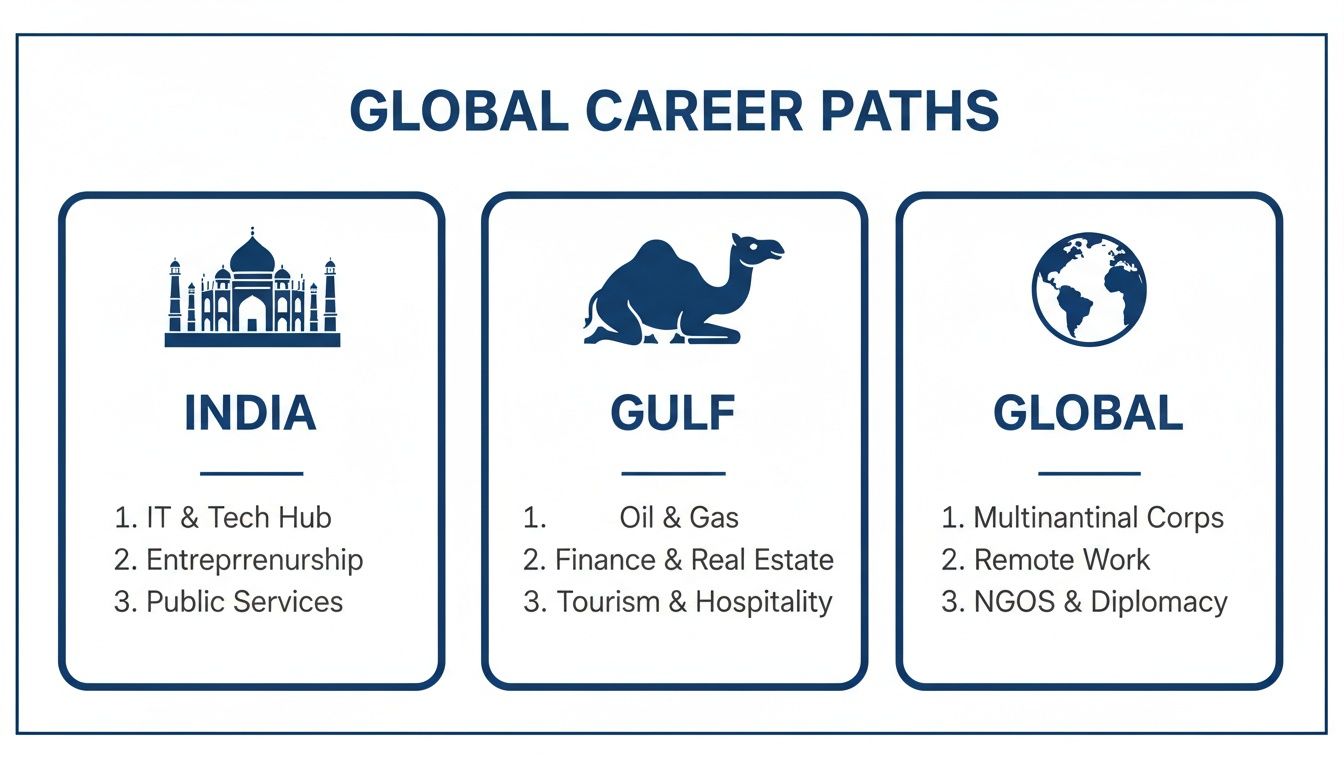
As you can see, your choice directly impacts where your career can take you. ACCA gives you broader international access, while the CPA provides a powerful advantage in US-focused markets.
CPA's Structure: An Intensive Deep Dive
The CPA exam, on the other hand, is an intense, concentrated challenge. It’s made up of four hefty sections that you must pass within a tight 18-month window. The focus isn't so much on breadth but on deep, technical mastery of US-specific standards.
The four sections are:
- Auditing and Attestation (AUD): Zeroes in on US auditing standards and procedures.
- Business Environment and Concepts (BEC): Covers corporate governance, economics, and financial management.
- Financial Accounting and Reporting (FAR): This is the beast of the exam, a deep dive into US GAAP.
- Regulation (REG): Tests your knowledge of US federal taxation and business law.
This structure demands an incredibly disciplined and focused study plan. It’s a great fit for people who can carve out a significant block of time for some serious, heads-down preparation.
Pass Rates and The Path to Success
Pass rates tell an interesting story in the ACCA vs CPA debate. On a paper-by-paper basis, ACCA exams are often more approachable. The data shows that ACCA has an average pass rate of around 55% for its computer-based exams. In contrast, the CPA's four tough sections see a lower average pass rate of 40-50%.
This difference isn't because one is "easier" than the other. It's really down to ACCA's structured levels versus the intense, specialised knowledge of US GAAP required for the CPA.
To give you a clearer picture, here’s a quick head-to-head comparison of their core features.
ACCA vs CPA: A Head-to-Head Comparison
This table offers a side-by-side summary comparing the core attributes of the ACCA and US CPA qualifications to help you make an informed decision.
| Attribute | ACCA (Association of Chartered Certified Accountants) | CPA (Certified Public Accountant – USA) |
|---|---|---|
| Structure | 13 papers across 3 levels (Knowledge, Skills, Professional) | 4 sections (AUD, BEC, FAR, REG) |
| Pacing | Flexible, self-paced marathon | Intense sprint with an 18-month window |
| Syllabus Focus | Broad, global principles (IFRS) with optional specialisations | Deep, technical focus on US standards (US GAAP, GAAS) |
| Average Pass Rate | Around 55% per paper | Around 40-50% per section |
| Best For | Working professionals, students seeking flexibility, global careers | Professionals needing US-specific expertise or planning to work in the US/with US firms |
Ultimately, choosing the right path comes down to what fits your life and your career goals.
"The true difficulty isn't just about the content. It’s about aligning the exam structure with your personal learning style and life circumstances. ACCA’s flexibility is a huge advantage for working professionals, while CPA's intensity suits those who can commit to a sprint." – Mr. Padmanaban, Chief Tutor
Success, however, isn't just about picking the right exam—it's about having the right support. This is where our Founder-Led Expertise becomes your biggest advantage. With over 30+ years of experience, Mr. Padmanaban personally mentors every student, making sure you get consistent, high-quality guidance for exam success.
For both qualifications, our "Study Anytime/Anywhere" Ecosystem is your key to balancing work, life, and studies. The Stride Edutech Mobile App gives you access to 300+ lecture hours, over 4000+ MCQs, and 1500+ solved problems that mirror the actual exam formats. This tool, free for our students, is a game-changer, especially for our learners in the Gulf who can access daily class recordings on their own time, easily overcoming any time zone differences.
Eligibility and Cost: A Practical Comparison
Before you dive into any global finance qualification, you need to ask two very practical questions: “Can I even apply?” and “How much is this going to cost me?” The ACCA and CPA paths are worlds apart on these two fronts, and understanding this is the first step in your ACCA vs CPA comparison. It’s where you make a real, informed choice about your future.
ACCA is known for being incredibly flexible with its entry rules, which is a massive plus for students in India. You can start your ACCA journey right after your 10+2 exams through the Foundation in Accountancy (FIA) route. This gets your foot in the door of a global qualification early, letting you build a solid foundation while you're still working on your bachelor's degree.
On the other hand, the CPA (USA) has much tougher academic hurdles that you simply can't negotiate.
CPA's Higher Entry Barrier
To even sit for the CPA exam, most states demand 120 college credit hours. Here’s the catch for Indian students: a standard three-year B.Com degree usually only gives you about 90 credits. It's not enough. To get licensed as a full-fledged CPA, the requirement jumps to 150 credit hours.
For most Indian graduates, this means having to complete a master's degree or other extra courses just to become eligible. That adds a lot of extra time and money to the clock. This eligibility gap is often the deal-breaker.
"The eligibility difference is fundamental. ACCA welcomes you early and grows with you, while CPA demands you meet a high academic standard before you can even begin. For many Indian students, this makes ACCA a more practical and accessible starting point." – Mr. Padmanaban, Chief Tutor
Comparing the Total Financial Investment
Beyond getting in, let's talk about the money. The total cost isn't just about exam fees; it includes registration, study materials, and coaching. A head-to-head look at the numbers shows where your investment goes.
| Fee Category | ACCA (Estimated) | CPA (USA) (Estimated) |
|---|---|---|
| Registration & Subscription | ₹20,000 – ₹25,000 | ₹30,000 – ₹40,000 (includes evaluation fees) |
| Total Exam Fees | ₹1,20,000 – ₹1,50,000 (for all 13 papers) | ₹1,00,000 – ₹1,20,000 (for all 4 sections) |
| Coaching & Materials | ₹80,000 – ₹1,50,000 | ₹1,20,000 – ₹2,00,000 |
| Estimated Total Investment | ₹2,20,000 – ₹3,25,000 | ₹2,50,000 – ₹3,60,000+ |
The total figures might look close, but the way you pay is very different. ACCA's costs are spread out over two to three years as you clear papers, which is much easier on the wallet for students and working professionals. CPA costs are packed into a much shorter, more intense timeframe.
This is exactly where a great training partner helps you get the most out of your investment. At Stride Edutech, our courses are built on our Founder-Led Expertise. Every student is mentored personally by Mr. Padmanaban, whose 30+ years of experience guarantees you get consistent, top-tier teaching focused on concept clarity to ensure exam success.
We also give you tools that make a tangible difference. Our Mobile App, free for all our students, is a huge cost-saver and a powerful study companion. With over 300+ lecture hours, 4000+ MCQs, and 1500+ solved problems, you get a complete study ecosystem right in your pocket. This "Study Anytime/Anywhere" tool is a game-changer for our students across India and the Gulf, helping them master their studies without sacrificing work or life.
Forecasting Salary Potential and Return on Investment
Let’s talk about the big question on every student's mind: what’s the return on investment? Choosing a professional qualification is a huge commitment of your time and money, so you need a realistic view of the career outcomes.
While both ACCA and CPA open doors to financially rewarding careers, they take you down different paths. Your salary will always depend on your role, location, and experience, but we see clear trends in India and the Gulf that can help you decide. Let's break down what you can realistically expect.
Salary Growth in India: The CPA Premium vs. ACCA Versatility
In India, the salary difference between ACCA and CPA is all about market demand. Both are highly respected, but CPAs often command a higher starting salary, especially if they land a job in the fast-growing US-based Global Capability Centre (GCC) ecosystem. Their specialised knowledge of US GAAP and regulations is a hot commodity.
On the other hand, ACCA professionals enjoy strong, steady career growth across a much wider range of industries. Their expertise in IFRS makes them a perfect fit for Big 4 firms, diverse MNCs, and large Indian companies with global footprints.
Mumbai & Bangalore: "In key metro hubs, an entry-level CPA in a US-focused GCC can start at ₹6 to ₹9 lakhs per annum (LPA), sometimes hitting ₹12 LPA. An ACCA fresher in a Big 4 advisory role typically starts around ₹4.5 to ₹7 LPA."
This initial gap often closes as you gain experience. With three to five years under their belt, ACCA members in IFRS-focused roles can see their salaries climb to ₹8-15 LPA. Over the same period, CPAs working in high-demand US compliance roles might see faster growth, reaching ₹12-20 LPA. These numbers highlight the slight premium the CPA holds in India, driven by the massive expansion of US-based operations.
For a deeper dive into these salary comparisons, check out the data on The Wall Street School's blog.
Earning Potential in the Gulf Market
In the Gulf, the story is completely different. The entire region—including the UAE, Saudi Arabia, Oman, Kuwait, Qatar, and Bahrain—runs on IFRS. This makes ACCA the go-to qualification for a huge number of finance jobs. From financial controllers to CFOs, ACCA members are in high demand across banking, construction, and energy sectors.
- Dubai & Abu Dhabi (UAE): An ACCA fresher can expect to earn between AED 8,000 to AED 12,000 per month. Mid-career professionals often earn AED 20,000 to AED 35,000.
- Riyadh & Jeddah (KSA): Salaries are quite similar. Early-career ACCAs can start with SAR 10,000 to SAR 15,000 monthly, while experienced members command SAR 25,000 to SAR 45,000.
While CPAs are also respected in the Gulf, their opportunities are mostly limited to American multinational headquarters. This gives ACCA a much broader market reach and makes it the more strategic choice for professionals building a long-term career in the region.
Ultimately, your earning potential isn't just about the certificate you hold; it’s about how well you were trained. This is where our Founder-Led Expertise truly sets you apart. With over 30+ years of experience, our Chief Tutor, Mr. Padmanaban, personally mentors every student to ensure you achieve concept clarity for exam success. Our "Study Anytime/Anywhere" Mobile App, packed with 300+ lecture hours and 4000+ MCQs, helps you study effectively around your work schedule, turning your investment into a high-value career.
How Stride Edutech Helps You Succeed in ACCA or CPA

Choosing between ACCA and CPA is a big decision, but it’s only the first step. Getting qualified is a marathon that demands the right guidance, a study plan that fits your life, and unwavering support. This is where Stride Edutech goes beyond a simple acca vs cpa comparison. We provide a clear, confident path to exam success, no matter which qualification you pick.
Our entire approach is built on Founder-Led Expertise. We believe consistent, high-quality teaching from a single, trusted source is the key to mastering complex topics. That’s why our Chief Tutor, Mr. Padmanaban, personally mentors every single course.
With 30+ years of experience shaping finance careers, he delivers the deep concept clarity and encouragement needed to tackle these tough exams. His direct mentorship ensures all our 10,000+ students receive the same exceptional guidance, a track record we are incredibly proud of.
The Best Solution for Working Professionals
We know exactly what it’s like for working professionals in India and students across the Gulf in the UAE, Saudi Arabia, Oman, Kuwait, Qatar, and Bahrain. Juggling a demanding job, family, and intense studies is a huge challenge, especially when dealing with different time zones.
Our "Study Anytime/Anywhere" Ecosystem was designed with you in mind. The heart of this system is the Stride Edutech Mobile App—the ultimate tool for flexibility. We upload daily class recordings straight to the app, so you can catch up on lectures whenever and wherever it suits your schedule, be it during a commute or after a late shift.
You no longer have to stress about missing a class because of a work commitment or a time zone conflict. Our Mobile App gives you the freedom to learn on your own terms, ensuring your career and studies can grow together.
Your Complete Toolkit for Exam Day
The Mobile App is so much more than a video library. It's a complete learning hub that puts everything you need at your fingertips. Once you enrol, you get free access to a powerhouse of study materials designed to build both your confidence and your skills. For those not enrolled, the app is also available for separate purchase.
Here’s what our Mobile App includes:
- 300+ lecture hours that cover the entire syllabus in detail.
- 4000+ MCQs to drill exam-style questions and master your timing.
- 1500+ solved problems that walk you through complex concepts step-by-step.
This blend of personal mentorship and powerful technology creates the support system you need to succeed. When you choose Stride Edutech, you’re not just signing up for a course; you’re joining a mentored programme committed to helping you earn your certification and unlock your true career potential.
Frequently Asked Questions
Making the final call between ACCA and CPA often boils down to a few specific, personal questions. We get it. Here, we've gathered the most common queries we hear from students and working professionals across India and the Gulf, with encouraging, mentor-led answers to help you decide with confidence.
For a BCom Graduate in the UAE, Should I Choose ACCA or CPA?
If you're a BCom graduate already working in the UAE, ACCA is almost always the smarter move. Its strong recognition across the entire Gulf Cooperation Council (GCC) and its focus on IFRS—the primary accounting standard used in the region—will unlock more doors for you locally.
Plus, ACCA's on-demand exam format is a lifesaver for anyone juggling a full-time job. While CPA is a powerhouse qualification, it makes the most sense if you're aiming for a role in an American multinational within the UAE or have clear plans to move to the US down the line.
Our Stride Edutech Mobile App is built for exactly this scenario. It gives you access to daily class recordings whenever you want, making it easy to fit your studies around a demanding work schedule, no matter where you are in the Gulf.
Do I Get Any ACCA Exemptions After Clearing CA Inter in India?
Absolutely, and it's a fantastic head start! If you've passed both groups of the CA Intermediate exam, you can claim exemptions for up to six papers in the ACCA qualification.
This clears the entire Applied Knowledge level (three papers) and three of the six Applied Skills papers. This shortcut drastically cuts down your study time and total cost, putting you on the fast track to a globally recognised qualification.
Our Chief Tutor, Mr. Padmanaban, has helped countless students with this exact background. He excels at building custom study plans to make sure you leverage these exemptions for maximum benefit on your path to exam success.
Is CPA Harder Than ACCA Because the Pass Rates Are Lower?
It's not that one is 'harder'—they're just different kinds of difficult. The CPA exam packs a massive amount of specialised, US-specific knowledge into just four exams. Each paper is incredibly dense, which is a major reason why the average pass rate per section is lower.
ACCA, on the other hand, spreads its broader, global curriculum across 13 exams. These are more manageable, bite-sized assessments, which naturally leads to higher pass rates for individual papers. Both demand serious discipline and dedication to succeed.
Our learning system, which includes over 4000+ MCQs and 1500+ solved problems on our Mobile App, is designed to build the deep concept clarity you need for either exam's unique style. It's an approach that has worked for our 10,000+ students, giving them the confidence to walk into the exam hall and pass.
Ready to take the next step with confidence? At Stride Edutech, our Founder-Led Expertise and flexible "Study Anytime/Anywhere" ecosystem are designed to guide you to exam success. Discover our courses and start your journey today. Learn more at Stride Edutech.