
When you're weighing Certified Management Accountant vs CPA, it’s crucial to understand this isn't just about different exams—it's about choosing a completely different career focus. As a mentor to aspiring finance professionals, my first piece of advice is always this: get absolute clarity on what drives you.
Think of it this way: the CMA USA is your path to becoming a strategic leader inside an organization. You'll be the one driving business decisions, planning for the future, and mastering performance analysis. In sharp contrast, the CPA is your license for a career in public accounting, where you’ll focus on auditing, tax, and ensuring financial reports are compliant for external stakeholders.
Your Quick Guide to CMA vs CPA

For ambitious students and working professionals in India and the Gulf/Middle East, getting this distinction right from the start is absolutely crucial for your success. One path positions you to shape a company's internal strategy, while the other makes you the trusted expert validating its external financial health.
This choice directly impacts your study plan, how you approach the exams for concept clarity, and the career you will build. Especially for busy working professionals balancing a job, picking the certification that aligns with your passion and goals is the key to passing the exams and achieving your ambitions.
To help you see the difference immediately, this quick summary table cuts straight to the point, comparing the most important attributes like job roles, exam structure, and typical career paths.
Key Insight: The CMA is for creating value from within a company. The CPA is for providing assurance from the outside. Your choice boils down to whether you want to build the business or audit it.
This table gives you a clear, side-by-side snapshot to quickly see which certification aligns better with your personal and professional goals. From here, we'll dive deeper into the specific details that will shape your career.
CMA vs CPA at a Glance
| Attribute | CMA (Certified Management Accountant) | CPA (Certified Public Accountant) |
|---|---|---|
| Primary Focus | Strategic management, performance analysis, and decision-making within an organisation. | Public accounting, auditing, tax compliance, and financial reporting for external stakeholders. |
| Core Role | A strategic business partner who guides internal financial decisions. | An independent advisor who ensures financial accuracy and regulatory compliance. |
| Typical Career Path | Financial Analyst, Controller, FP&A Manager, Chief Financial Officer (CFO). | Public Accountant, Auditor, Tax Specialist, Forensic Accountant. |
| Governing Body | Institute of Management Accountants (IMA) – A global body. | American Institute of CPAs (AICPA) and U.S. State Boards – A U.S.-based license. |
| Exam Structure | Two parts (can be taken in any order). | Four sections (Core + one Discipline). |
Understanding the Core Focus of Each Certification
When you’re weighing Certified Management Accountant vs CPA, the first step toward exam success is to achieve absolute concept clarity on what each certification represents. They aren’t just two paths to the same place; they build entirely different skill sets and open very different career doors. Getting this right from the start is key to acing the exams and, more importantly, building a career you love.
The CMA (Certified Management Accountant), awarded by the globally recognized Institute of Management Accountants (IMA), is the gold standard for professionals who want to work inside a company's finance and strategy teams. Think of a CMA as an internal business strategist, always looking toward the future.
The Role of the CMA: The Internal Strategist
CMAs are the people who help shape a company's financial future from the inside. Their job is to dive deep into internal data, steer the budget, and offer the critical insights that drive the business forward and create long-term value.
You'll find them heavily involved in:
- Strategic Planning: Working with leadership to make smart decisions on new products, market expansion, or major investments.
- Performance Management: Analyzing which parts of the business are running efficiently and which are lagging.
- Cost Management: Finding opportunities to trim expenses and boost profitability.
A CMA's work has a direct impact on a company's direction. They’re less about ticking boxes for past compliance and more about drawing the map for future growth. This is exactly why the CMA USA is in such high demand at MNCs across India and the Gulf.
The Role of the CPA: The Public Guardian
On the other hand, the CPA (Certified Public Accountant) is a U.S. state-level license that marks you as an expert in public accounting. A CPA’s main responsibility is to provide assurance to people outside the company—like investors, banks, and government regulators. You can get a full breakdown in our comprehensive guide to the CPA certification.
Their work is more backward-looking, ensuring a company's financial history is presented accurately and ethically. Their key tasks include:
- Auditing: Scrutinizing financial statements to make sure they are fair and free of major errors.
- Tax Preparation: Navigating the complex maze of tax laws to ensure the company is fully compliant.
- Advisory Services: Guiding companies on how to apply intricate financial reporting rules.
Here’s a simple way to think about it: A CMA is in the driver's seat, using data to help the company decide where to go next. A CPA is the independent inspector, checking the vehicle and the trip logs to make sure the journey was reported correctly for everyone watching from the outside.
This difference is everything, especially for working professionals. If you get excited about shaping business strategy and driving decisions from within, the CMA is your calling. But if you find satisfaction in upholding financial integrity and building public trust, then the CPA is the clear choice. Nailing down this core difference is the most important first step you can take.
CMA vs CPA: A Look at Eligibility and Exam Structure
When you’re a finance professional in India or the Middle East eyeing a global certification, the real decision-making starts with the practicalities: eligibility and exams. This is where the Certified Management Accountant vs CPA debate gets personal, moving beyond theory to what you can realistically achieve while balancing work and life.
The CMA USA qualification often presents a more direct and achievable route, especially if you're juggling a full-time job. Its requirements are designed to be inclusive, which is a massive advantage for many professionals in our region. It’s about opening doors, not putting up walls.
Eligibility: The CMA's Open Door vs. the CPA's Steep Climb
The first hurdle is your educational background, and this is where the two paths truly diverge. It’s often the make-or-break factor for candidates.
- CMA USA Eligibility: You simply need a bachelor's degree (from any stream) and two years of relevant work experience. The best part? You can gain that experience after you’ve passed the exams, giving you incredible flexibility.
- CPA Eligibility: This is a much tougher nut to crack. It demands 120-150 credit hours of specific coursework. For many Indian graduates whose degrees don't easily convert to this system, this can be a significant obstacle.
For the millions of commerce graduates in India and the Gulf, the CMA’s flexible policy is a game-changer. It’s why so many see it as a faster track to a global qualification, often achievable in just 6-12 months compared to the 18-24 months typical for the CPA.
The Exam: A Sprint vs. a Marathon
Beyond eligibility, the exams themselves are structured differently. This directly impacts your study plan and timeline. Both demand serious dedication—average pass rates for both hover around a challenging 45-50%—but the journey to success looks very different.
This timeline gives you a great visual of the commitment each path requires.
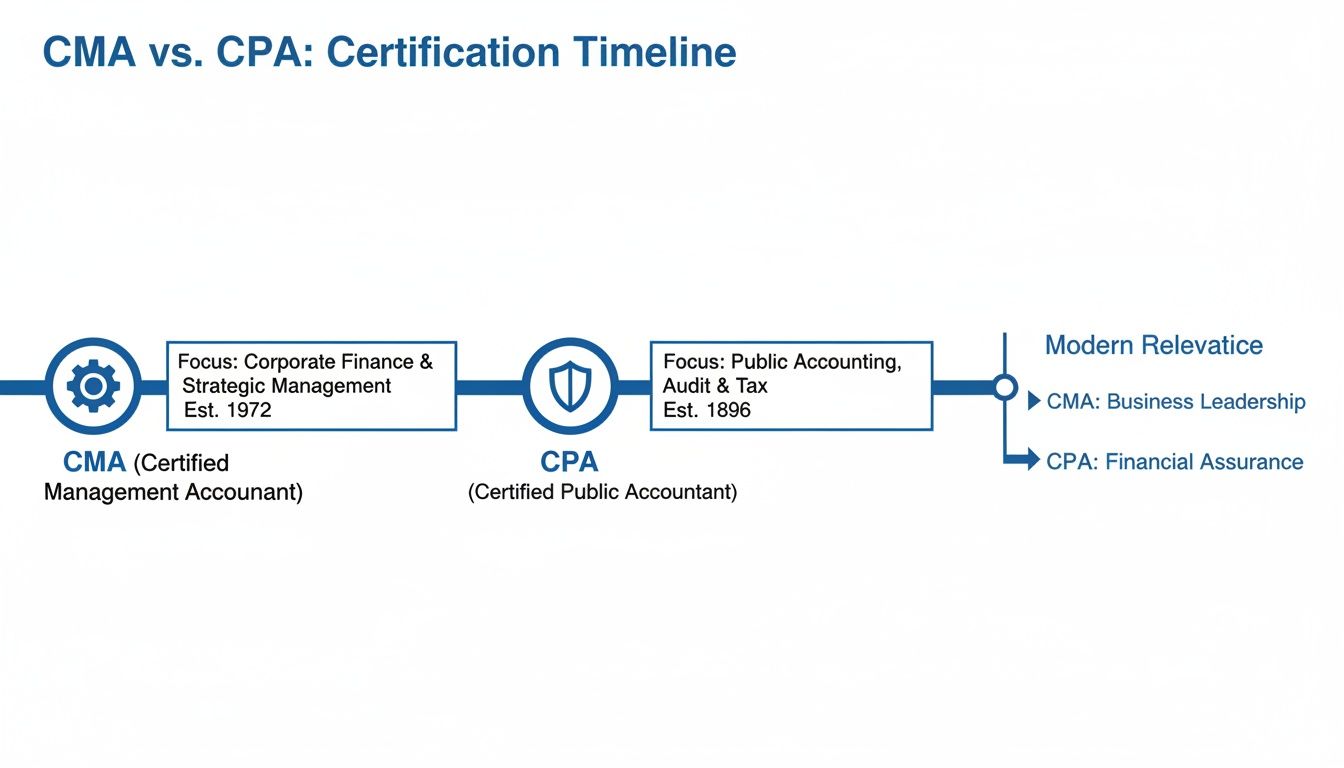
As you can see, the CMA journey is intentionally more focused, which is a key reason working professionals find it so manageable and appealing.
CMA USA Exam:
Think of the CMA exam as a two-part sprint. You can even choose which part to run first, allowing you to play to your strengths and build momentum.
- Part 1: Financial Planning, Performance, and Analytics
- Part 2: Strategic Financial Management
This structure is perfect for professionals who need to fit studying around a busy work schedule. You can pour all your energy into one part, clear it, and then tackle the next. For a deeper look, check out our detailed guide on the CMA USA exam structure.
CPA Exam:
The CPA exam is a four-part marathon. It demands a massive breadth of knowledge across different areas of public accounting.
- Auditing and Attestation (AUD)
- Financial Accounting and Reporting (FAR)
- Regulation (REG)
- Discipline Sections (replacing the old BEC)
Mentor’s Takeaway: In my 30+ years of mentoring students, including the 10,000+ we’ve successfully trained at Stride Edutech, the CMA's two-part structure is a huge win for working professionals. It allows for focused, manageable study periods, which is absolutely critical whether you're dealing with a demanding job in India or a shift-based role in the Gulf.
Our entire "Study Anytime/Anywhere" ecosystem, powered by the Stride Edutech Mobile App, was created for this exact reality. With over 300+ lecture hours and 4000+ MCQs on demand, our students in India and the UAE achieve the concept clarity they need to pass on their own schedule.
Analyzing Career Paths and Salary Potential
Let's get to the most important question: where do these certifications actually take you? When it comes to the Certified Management Accountant vs CPA debate, understanding the career paths and salary potential is everything for making an informed choice. This is where the two qualifications really show their differences, especially in the fast-growing markets of India and the Middle East.
Your choice here isn't just about an exam; it's about the entire trajectory of your career.
The CMA Career Trajectory: The Corporate Strategist
Think of the CMA USA as your gateway to the strategic core of a business. It’s designed for professionals who want to influence strategy, manage performance, and drive decisions from the inside. The career ladder for a CMA is built right within the company, often leading straight to the C-suite.
You’ll start in roles that give you a deep understanding of business operations and then climb into positions that literally shape the company's future.
A typical CMA journey often looks like this:
- Entry-Level: Financial Analyst, Cost Accountant, Junior Internal Auditor
- Mid-Career: Senior Financial Analyst, FP&A (Financial Planning & Analysis) Manager, Cost Controller
- Senior-Level: Finance Director, Vice President of Finance, and the ultimate goal for many—Chief Financial Officer (CFO)
These roles are in high demand in multinational corporations (MNCs), manufacturing firms, and tech companies across India and the Gulf. Companies aren't just looking for number crunchers; they need strategic thinkers who can turn data into profit and growth. That's exactly what a CMA does.
The CPA Career Path: The Public Trust Expert
The journey for a CPA, on the other hand, usually starts in the world of public accounting. The first few years are often spent at big firms (like the Big Four), where you'll build a rock-solid foundation in audit, tax, and compliance based on U.S. standards.
While many CPAs build their entire careers in public accounting, others use this powerful experience to move into specialised roles within corporations.
Here’s a common career path for a CPA:
- Entry-Level: Audit Associate, Tax Staff, or Junior Accountant in a public firm
- Mid-Career: Senior Auditor, Tax Manager, Forensic Accountant
- Senior-Level: Audit Partner, Director of Internal Audit (in a corporate setting), Tax Director
CPAs are highly valued in corporate settings, but their expertise is typically focused on ensuring financial integrity and compliance—think internal audits and financial reporting. This is quite different from the forward-looking, strategic planning role that defines a CMA.
Mentor's Insight: I often explain it to our students in India and the Gulf like this: The CMA is the one building and fine-tuning a company's financial engine. The CPA is the expert who inspects that engine to make sure it's running perfectly and by the rules. Both are absolutely critical, but your passion should decide which job you want.
A Deep Dive into Salary Potential in India and the Middle East
Now, let's talk numbers. In India, a fresher with a Certified Management Accountant (CMA US) certification can expect to start with a salary between ₹6-9 lakhs per year. With 3-6 years of experience, this quickly climbs to ₹10-18 lakhs in mid-level roles.
While a Certified Public Accountant (CPA US) might have a slight edge at the entry-level, often starting around ₹8 lakhs annually, CMAs tend to see faster salary growth in corporate finance tracks. You can get a full breakdown in our detailed guide on CMA USA salary trends.
This rapid growth happens because the strategic skills you learn in the CMA curriculum—with a focus on concept clarity—are exactly what today's corporations in India and the Gulf are looking for. The Institute of Management Accountants (IMA) even reports that CMAs can earn up to 58% more than their peers without the certification. For students who want a faster return on their investment, the CMA's focused, two-part exam is a huge advantage.
Ultimately, both certifications lead to respected, high-paying careers. However, the CMA path often provides a more direct route to high-impact, strategic leadership positions inside a company, and its impressive salary growth in markets like India and the UAE reflects that.
How to Choose the Right Certification for You
The Certified Management Accountant vs CPA debate isn't about which one is "better." It's about which one is better for you. This decision really boils down to your personal ambition and the practical realities of your career, especially if you're working in India or the Middle East.
Instead of just listing pros and cons, let's look at this through a couple of real-world scenarios. The right answer comes from asking yourself some honest questions about where you see your career heading.
Scenario One: The Corporate Strategist
Do you get excited by the idea of shaping a company’s future from the inside? If you see yourself climbing the ladder to become a CFO, a strategic business partner, or a decision-maker at a big MNC, the choice becomes pretty clear.
- Choose CMA if: You want to influence business strategy, not just report on it.
- Choose CMA if: Financial planning, performance analysis, and using data to drive growth are what you enjoy.
- Choose CMA if: Your goal is to lead in sectors like manufacturing, tech, or e-commerce in India or the Gulf.
The CMA is built for professionals who want to be at the heart of the business, actively creating value.
Scenario Two: The Public Trust Guardian
On the other hand, do you find deep satisfaction in ensuring accuracy, upholding financial standards, and providing objective assurance? If your dream is to become an audit partner at a Big Four firm or a specialist in forensic accounting, your path is just as clear.
- Choose CPA if: Your heart is set on a career in public accounting, specifically in audit or tax.
- Choose CPA if: You're passionate about financial integrity, compliance, and being the trusted voice for external stakeholders.
- Choose CPA if: The structured, rules-based world of public practice is where you feel you belong.
The core difference is simple: The CMA is for creating value from within an organisation. The CPA is for providing assurance from the outside.
A Practical Look at the Indian and Gulf Job Markets
Your career goals must align with the demands of the job market in India and the Middle East. For corporate climbers in India, the CMA USA often provides a more direct route to the top. Mid-career professionals with 3-6 years of experience can command salaries of ₹10-18 lakhs as senior analysts. Leadership roles like CFO can soar to ₹60 lakhs-1.5 crores.
This often outpaces the steady, but more audit-focused, trajectory for CPAs. For those looking to work in the Gulf, the CMA’s global recognition is a huge plus, with mid-level roles in the UAE earning AED 12,000-20,000 monthly. You can discover more insights about these career paths from recent analyses.
This doesn't mean the CPA is less valuable. It offers significant premiums in specialised roles like tax advisory and forensics. However, for the majority of professionals targeting rapid advancement within MNCs, the CMA aligns better with current market demand.
Making this decision takes introspection. With the guidance of a mentor like our Chief Tutor, Mr. Padmanaban, who brings 30+ years of experience to the table, you can gain real clarity. At Stride Edutech, we've helped over 10,000+ students navigate this exact choice, focusing on deep concept clarity to ensure exam success, no matter which path they take.
Your Path to Success Starts with the Right Partner

Deciding between Certified Management Accountant vs CPA is the first big step. The next, and arguably more important, is choosing how you’ll prepare for exam success. These tough exams require more than just study material; they demand a smart strategy and an experienced guide in your corner.
At Stride Edutech, we are dedicated to ensuring you not only pass your exams but truly master the concepts for a thriving career. Our entire approach is built on this promise.
This commitment is delivered through our founder-led expertise. We’re not a faceless corporation. Every single course is personally taught and mentored by our Chief Tutor, Mr. Padmanaban. With 30+ years of real-world experience, his direct involvement ensures you receive consistent, high-quality teaching that’s rich with insights you won’t find in any textbook. It is this personal mentorship that guarantees concept clarity and sets our students up for success.
We Built Our Program for Working Professionals
We understand the challenges. Juggling a demanding job with intense study is tough, especially for professionals in India and the Gulf. That’s why we designed our entire "Study Anytime/Anywhere" ecosystem. The heart of this model is our powerful Mobile App.
Forget rushing to class after a long day or worrying about time zones. We upload recordings of our daily live classes directly to the app. This gives you complete control. You can catch up on lectures during your commute in India or watch them at your convenience after a work shift in the UAE.
This flexibility isn’t just a feature; it's how we help busy professionals achieve their goals. We make sure your studies fit into your life, not the other way around.
Our goal is simple: to help you turn ambition into achievement. By pairing Mr. Padmanaban's deep expertise with the flexibility of our Mobile App, we’ve created a support system that works for a modern professional's life and ensures you are ready for exam day.
All the Tools You Need in One App
Our Mobile App is more than just a video player. It’s a complete study system designed to give you the confidence to ace your exams.
Our app is free for all enrolled students and is also available for separate purchase. It includes:
- 300+ lecture hours: In-depth video lessons covering every topic on the syllabus for complete concept clarity.
- 4000+ MCQs: A huge bank of practice questions to test your knowledge and sharpen your exam technique.
- 1500+ solved problems: Detailed, step-by-step solutions that show you exactly how to tackle complex questions.
This blend of expert mentorship and powerful, flexible tools has helped us successfully train over 10,000+ students. We don’t just get you exam-ready; we give you the deep conceptual understanding you need to stand out in your career.
Join the thousands of successful alumni who started their journey with us. Your path to becoming a certified finance leader starts now.
Frequently Asked Questions
As you weigh the CMA vs CPA decision, a few practical questions almost always come up. Let's tackle the most common ones our students ask, so you can move forward with total clarity.
Can I Do Both CMA and CPA?
Absolutely, and it’s a powerful combination. Holding both a CMA and CPA makes you a formidable candidate for C-suite roles, blending internal strategic finance with public-facing compliance expertise.
But here's my honest advice, based on mentoring over 10,000+ students: it's a marathon, not a sprint. Focus on one qualification first—the one that aligns with your immediate career goals. Get that win, build momentum, and then consider adding the second.
Which Is Better for a Career in the Middle East?
Both the CMA (USA) and CPA are highly valued across the Gulf. The "better" choice depends entirely on the career door you want to open.
- The CMA is your ticket to the heart of the business. It's the go-to credential for corporate finance roles in the UAE, Saudi Arabia, and Qatar—think financial planning & analysis (FP&A), strategic management, and business analysis. It’s for people who want to drive business growth from the inside.
- The CPA is the gold standard for public accounting. If your goal is to work in audit and assurance, especially at a Big Four firm in the region, the CPA is non-negotiable.
Which Exam Is More Manageable for a Working Professional?
This is a critical point for our students in India and the Gulf who are balancing a full-time job. Without a doubt, the CMA exam is generally seen as more manageable for working professionals.
Its two-part structure gives you the flexibility to tackle one exam at a time. This approach breaks down the study process into achievable milestones, fitting much more realistically around a demanding work schedule and leading to higher chances of exam success.
This is exactly why we built the Stride Edutech "Study Anytime/Anywhere" ecosystem. We upload daily class recordings to our Mobile App, so you can master complex topics on your own schedule. It completely removes the stress of fixed classes and clashing time zones for our students in the Gulf and across India.
Our entire coaching model is designed to make exam success a reality for busy professionals. We provide the tools and founder-led mentorship; you bring the commitment. Under the direct guidance of our Chief Tutor, Mr. Padmanaban, you get a study plan backed by his 30+ years of industry experience, ensuring every hour you spend is focused and effective.
Ready to take the next step with expert guidance tailored for your success? Explore the courses at Stride Edutech and see how our proven methodology can help you achieve your certification goals. Find your path here: https://strideedutech.com.