
Think of accounting as a universal language that every major company in the world needs to speak. For ambitious professionals, that language is IFRS (International Financial Reporting Standards). If you're aiming for exam success and true concept clarity, this guide is your first step towards fluency, breaking down why IFRS is the global benchmark for financial transparency and trust.
Your Journey Into Global Accounting Starts Here

For ambitious students and working professionals in India and the Gulf/Middle East (UAE, Saudi Arabia, Oman, Kuwait, Qatar, Bahrain), mastering IFRS isn't just an option—it's a career-defining move. These standards create a single, high-quality set of accounting rules that make business possible across borders. When a company in Dubai reports its earnings using IFRS, an investor in Mumbai can understand and trust those numbers instantly, fostering global confidence.
This universal framework is powerful. It boosts investor confidence, helps companies raise capital globally, and opens incredible career opportunities. It elevates your role from just recording numbers to becoming a strategic advisor who can interpret financial data for a global audience. Before we dive deep, let's establish a solid foundation.
IFRS at a Glance: Key Concepts for Beginners
| Concept | What It Means for You | Why It Matters for Your Exam Success |
|---|---|---|
| Principles-Based Approach | Instead of rigid rules, IFRS gives you a framework to apply professional judgment. | You'll be tested on your ability to interpret scenarios, not just memorise rules. This is where concept clarity is crucial. |
| Fair Value Accounting | Assets and liabilities are often reported at their current market value, not just their historical cost. | Understanding how to calculate and apply fair value is a common and critical exam topic, especially for IFRS 13. |
| Substance Over Form | You account for the economic reality of a transaction, not just its legal form. | Exam questions often present complex contracts; you must identify the true financial impact to succeed. |
| Global Comparability | The primary goal is to make financial statements from different companies and countries comparable. | This is the "why" behind IFRS. Remembering this helps you understand the purpose of each standard and answer questions with confidence. |
Grasping these four concepts is your first big step. They are the bedrock of IFRS, and you’ll see them reappear as you study specific standards like IFRS 15 (Revenue) and IFRS 16 (Leases).
Founder-Led Expertise: Your Mentor for Success
Learning IFRS can feel daunting, but you don't have to do it alone. At our core is our Founder-Led Expertise. All courses are personally mentored by our Chief Tutor, Mr. Padmanaban, who brings over 30+ years of experience. He personally mentors all courses, ensuring consistent, high-quality teaching for every student. His mission is to help you achieve true concept clarity and exam success.
Under his direct mentorship, we have successfully trained over 10,000+ students. This is our track record of helping students conquer the complexities of global accounting and ace their exams.
The "Study Anytime/Anywhere" Ecosystem for Professionals
We understand the challenges of balancing a demanding job with your studies, especially for working professionals in India and the Gulf. Long hours in Dubai or a hectic commute in Mumbai shouldn't stop your ambition.
This is why we created the "Study Anytime/Anywhere" ecosystem, centered around our powerful Mobile App.
Daily class recordings are uploaded directly to the app, allowing Gulf students and professionals to catch up on lectures at their own convenience, regardless of time zones or work shifts. Your lessons are always in your pocket, ensuring you never fall behind.
Our Mobile App is your ultimate toolkit for exam success, packed with resources:
- 300+ lecture hours for in-depth understanding.
- 4000+ MCQs to sharpen your skills for exam day.
- 1500+ solved problems to see how theories are applied.
This powerful tool is free for our enrolled students and also available for separate purchase, putting you in control of your learning journey.
Why India and the Middle East Embraced IFRS
The move towards IFRS in India and the Middle East was a fundamental upgrade to their financial operating systems. For nations serious about attracting global investment and integrating into the world economy, speaking this single, trusted accounting language became essential. This unlocked massive opportunities for local companies and created a huge demand for finance professionals fluent in IFRS.
For countries in the Gulf Cooperation Council (GCC)—the UAE, Saudi Arabia, Qatar, Kuwait, Bahrain, and Oman—adopting IFRS was a strategic necessity. As these economies diversified beyond oil and gas, they needed to attract foreign capital. By mandating IFRS, they sent a clear signal to international investors: "Our financial data is transparent, reliable, and comparable." This builds investor confidence and makes it easier for local giants to list on international stock exchanges.
This strategic alignment has ignited a strong job market for finance professionals across the Middle East. Companies from Dubai to Riyadh are constantly seeking talent who can navigate IFRS, making it a non-negotiable skill for a serious finance career in the region.
India's Journey to Ind AS
India's story is a fascinating one of strategic convergence. Instead of adopting IFRS wholesale, India developed Ind AS (Indian Accounting Standards), which are deeply converged with IFRS but include specific "carve-outs" to fit the Indian economic landscape. This transition completely changed the game for every CA, CS, and CMA USA student and professional in the country.
The mandatory rollout of Ind AS began in 2016-2017, based on a roadmap set by the Ministry of Corporate Affairs. The transition was phased:
- Phase I: Targeted companies with a net worth over ₹500 crore, starting from April 1, 2016.
- Phase II: Expanded to those with a net worth between ₹250-500 crore, from April 1, 2017.
Today, with new IFRS amendments always on the horizon, continuous learning is crucial for Indian professionals. Mastering Ind AS and the IFRS principles behind it is no longer just a good idea—it's a core requirement for exam success and career advancement in the Indian finance sector.
What This Means for Your Career
For you, this convergence is a golden opportunity. Fluency in IFRS makes you a highly valuable asset, whether you aim to work for a multinational in Mumbai or a fast-growing enterprise in the UAE. It proves you speak the global language of business. You can explore our guide on the top countries to work as an ACCA qualified accountant to see the worldwide opportunities these skills unlock.
This is where true concept clarity becomes your greatest advantage. It’s about understanding the 'why' behind the rules. At Stride Edutech, this philosophy is at the core of our teaching.
All our courses are personally mentored by our Chief Tutor, Mr. Padmanaban, who brings 30+ years of experience to the classroom, ensuring every one of our 10,000+ students receives consistent, top-quality guidance.
We also understand your time is precious. That's why our "Study Anytime/Anywhere" ecosystem, powered by our Mobile App, gives you the flexibility to learn on your schedule. With 300+ lecture hours, 4000+ MCQs, and 1500+ solved problems, you have all the tools for exam success right in your pocket.
Decoding the Core Principles of IFRS

To truly understand what is IFRS, you must grasp its core philosophy. IFRS is not a rigid rulebook; it’s a principles-based framework. It trusts you to use professional judgment to show the true economic picture of a business. This approach shifts your role from a number-cruncher to a strategic advisor. For your exams, this means one thing is crystal clear: genuine concept clarity beats rote learning every single time.
The Power of Principles Over Rules
Two foundational concepts you must master are Fair Value and Substance Over Form.
Fair Value: This principle requires you to report assets and liabilities at their current market worth, not their original cost. This gives investors a more realistic view of a company's financial health right now.
Substance Over Form: This powerful principle demands you account for the economic reality of a transaction, not just its legal paperwork. It prevents companies from using legal loopholes to hide what's really happening.
Mastering these two principles is essential for exam success. Questions are designed to test your application of these ideas to new scenarios, not just your ability to recite a definition.
This is where the mentorship of our Chief Tutor, Mr. Padmanaban, is a game-changer. With over 30+ years of experience, he excels at turning abstract principles into practical knowledge. He has successfully guided over 10,000+ students by focusing on this deep, intuitive understanding.
Your Toolkit for Mastering IFRS Principles
We know that for busy professionals in India or the Gulf, balancing a demanding job with studies is a challenge. That’s why we built our "Study Anytime/Anywhere" learning ecosystem with you in mind. Our Mobile App is your go-to study partner.
Daily class recordings are uploaded straight to the app. This means you can catch up on lectures whenever it suits you—on your commute, during a break, or late at night, no matter your time zone. The app is packed with resources to help you master these core principles:
- 300+ lecture hours that break down every concept, step-by-step.
- 4000+ MCQs to sharpen your ability to apply principles under exam pressure.
- 1500+ solved problems that show you how professional judgment is applied in real-life case studies.
With these tools, you can build the rock-solid conceptual foundation you need to excel.
A Practical Look at Key IFRS Standards
Moving from theory to practice is where real learning begins. Let's dig into three critical and frequently tested standards: IFRS 15 (Revenue), IFRS 16 (Leases), and IFRS 9 (Financial Instruments). Understanding these standards isn't just about passing exams; it's about understanding the language of global business. This practical application is the heart of what we do at Stride Edutech, where every concept is brought to life.
IFRS 15 Revenue from Contracts with Customers
IFRS 15 introduced a single, powerful five-step model for recognizing revenue. The core idea is to recognize revenue only when control of a good or service is transferred to a customer.
The five-step model is your roadmap:
- Identify the contract.
- Identify the performance obligations (distinct promises).
- Determine the transaction price.
- Allocate the price to each promise.
- Recognise revenue as each promise is fulfilled.
Think of a telecom company selling a phone with a two-year service plan. IFRS 15 forces them to split the total price between the handset (revenue recognised upfront) and the monthly service (revenue recognised over the 24-month plan).
IFRS 16 Leases
This standard was a game-changer, bringing most leases onto the balance sheet and revealing previously hidden debt. Before IFRS 16, companies could keep massive lease commitments 'off-balance sheet,' obscuring their true financial risk.
Under IFRS 16, a company must recognise a ‘right-of-use’ asset and a corresponding lease liability on its balance sheet, giving a more honest view of its financial health.
A Simple Example: Leasing an Office
A company in Dubai signs a 5-year office lease. It calculates the present value of all future lease payments, which becomes the Lease Liability and an equal Right-of-Use Asset. Each year, it records depreciation on the asset and interest expense on the liability. The commitment is no longer hidden.
IFRS 9 Financial Instruments
IFRS 9 is a huge deal, especially for banks. It overhauled how companies classify financial assets and introduced a more forward-looking 'expected credit loss' model. For professionals in India, the convergence to Ind AS (based on IFRS 9) has dramatically increased the transparency of financial reporting.
Looking ahead, amendments to IFRS 9 and 7 will become effective on January 1, 2026, clarifying how to account for assets with ESG-linked features, based on strong support from the IASB's 2024 consultations. You can discover more insights about these upcoming IFRS changes and their impact on primaconsulting.org.
Mastering these standards is non-negotiable for exam success. It takes dedicated practice and expert guidance. This is where our learning ecosystem, personally mentored by Chief Tutor Mr. Padmanaban, makes all the difference.
Our Mobile App is the ultimate study partner, built for busy professionals in India and the Gulf. It lets you Study Anytime/Anywhere and conquer these topics with:
- 300+ lecture hours that break down every standard.
- 1500+ solved problems showing you how to apply IFRS 15, 16, and 9.
- 4000+ MCQs to drill your knowledge and prepare you for exam questions.
This mix of founder-led expertise and flexible learning has already helped over 10,000+ students achieve genuine concept clarity.
IFRS vs Ind AS vs US GAAP: Navigating The Key Differences
For finance professionals in India or the Gulf, understanding the differences between IFRS, Ind AS, and US GAAP is a critical skill for exam success. Exams love to test your ability to compare these frameworks, so achieving concept clarity here is essential.
Think of them as different dialects of the same accounting language. For example, US GAAP allows the LIFO (Last-In, First-Out) inventory method, but both IFRS and Ind AS have banned it. Knowing these nuances is crucial for global exams like the CMA USA or ACCA.
The Story Behind Ind AS "Carve-Outs"
India didn't just copy-paste IFRS; it created Ind AS with specific tweaks known as "carve-outs" to fit India’s unique economic and legal system. For instance, Ind AS requires a single, all-in-one statement of profit and loss, whereas IFRS offers a choice between one or two statements.
Grasping these carve-outs shows examiners you have a deeper, practical understanding. This deep comparative analysis is a cornerstone of the teaching methodology personally overseen by our Chief Tutor, Mr. Padmanaban, across all our courses.
The Ind AS rollout has significantly improved transparency in India, making local companies more attractive to global investors. You can see how different countries use these standards on the official IFRS site.
The infographic below highlights key standards where treatments often differ.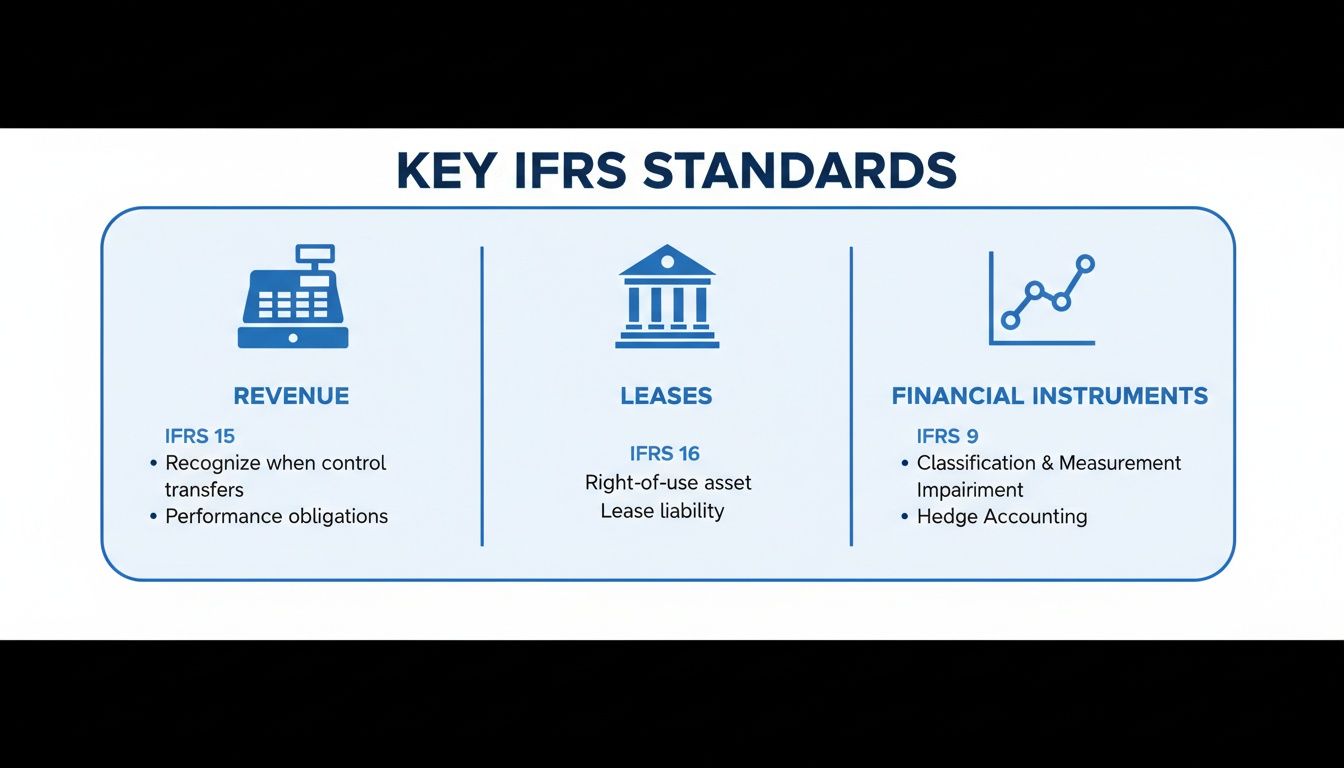
Getting a solid grip on these is crucial for understanding the differences between IFRS, Ind AS, and US GAAP.
Key Differences IFRS vs Ind AS vs US GAAP
This focused comparison table highlights major differences you need to know for your exams.
| Accounting Area | IFRS Treatment | Ind AS Treatment (Carve-out) | US GAAP Treatment |
|---|---|---|---|
| Inventory Valuation | FIFO or Weighted Average. LIFO is prohibited. | Same as IFRS; LIFO is prohibited. | FIFO, Weighted Average, and LIFO are all permitted. |
| Statement of Profit & Loss | Choice of a single statement or two separate statements (Income & Comprehensive Income). | Requires a single Statement of Profit and Loss, including Other Comprehensive Income. | Follows a single-statement approach but allows OCI items to be presented on the face of the statement or in a separate statement. |
| Investment Property | Choice of Cost Model or Fair Value Model (with changes in P&L). | Only the Cost Model is permitted. Fair value disclosures are required in notes. | No specific "Investment Property" category. Generally accounted for at cost, subject to impairment. |
| Lease Accounting (Lessee) | Single model: all leases are recorded on the balance sheet as Right-of-Use (ROU) assets and lease liabilities. | Aligned with IFRS 16; single on-balance-sheet model. | Dual model: leases are classified as either Finance or Operating leases, affecting how they are expensed. |
| Revenue Recognition | A single, five-step model for all industries (IFRS 15). | Converged with IFRS 15, so the same five-step model applies. | Broadly similar to IFRS 15, but with some differences in guidance for specific industries (e.g., software). |
Mastering these distinctions will build your confidence and help you tackle comparative questions with ease.
Your Path To Mastering Global Standards
Comparing these complex standards requires expert guidance. For professionals in the Gulf or India juggling work and studies, our "Study Anytime/Anywhere" ecosystem was built for you. The Stride Edutech Mobile App puts everything you need in your pocket.
- 300+ lecture hours that break down these subtle differences with clear, practical examples.
- 4000+ MCQs to test your comparative knowledge and get you exam-ready.
- 1500+ solved problems that walk you through real-world scenarios applying IFRS, Ind AS, and US GAAP.
With founder-led expertise from Mr. Padmanaban and a track record of training 10,000+ students, we provide the mentorship and resources you need to confidently achieve exam success.
Your Path to IFRS Mastery With Stride Edutech
Mastering IFRS is your ticket to career growth in the competitive finance landscapes of India and the Gulf. It signals your commitment to global best practices. But getting there requires more than just textbooks; you need expert guidance and a learning structure that fits your life. That’s what you get with Stride Edutech.
Founder-Led Expertise You Can Trust
At the heart of Stride Edutech is our Chief Tutor, Mr. Padmanaban. He brings 30+ years of experience to every lesson and personally mentors all our courses, ensuring a consistent, high-quality teaching standard that is rare to find. This founder-led expertise means every student benefits directly from his deep, real-world knowledge.
We believe that exam success comes from genuine concept clarity. This core philosophy has helped us successfully train over 10,000+ students, guiding them to not only pass their exams but to truly understand the 'why' behind the standards.
A Learning Ecosystem for Busy Professionals
We understand the challenges of balancing a demanding job with ambitious study goals. For working professionals in India and the Gulf, you need a solution that adapts to you.
This is why we created our "Study Anytime/Anywhere" ecosystem, powered by the Stride Edutech Mobile App. Daily class recordings are uploaded right away, allowing you to catch up on lectures whenever it works for you—on your commute, during a break, or late at night.
Our Mobile App is your complete IFRS toolkit for exam success:
- 300+ lecture hours covering every detail of the IFRS syllabus.
- 4000+ MCQs to sharpen your skills under pressure.
- 1500+ solved problems that walk you through practical applications.
This powerful combination of expert mentorship and flexible technology puts you in control of your learning journey.
For those ready to take that next step, you can learn more about our comprehensive https://strideedutech.com/ifrs-course/ and see how it can accelerate your career. Your journey to IFRS mastery starts now.
Frequently Asked Questions About IFRS
We’ve covered a lot, but you likely still have some practical questions. Getting these answers straight will help you see the path ahead more clearly.
Is IFRS Difficult for Someone With Only Indian GAAP Knowledge?
This is a common worry, but don't be intimidated. The move is more about shifting your mindset to a principle-based approach. Our courses, personally mentored by our founder Mr. Padmanaban, are built to bridge this exact gap. We focus on building your understanding from the ground up to ensure you achieve true concept clarity. Plus, with 1500+ solved problems on our Mobile App, you’ll get tons of practice applying these new principles, making the transition feel manageable.
How Can I Study for IFRS Exams While Working a Full-Time Job in the Gulf?
We designed the Stride Edutech "Study Anytime/Anywhere" system precisely for this challenge. Our Mobile App is your secret weapon. Daily class recordings are uploaded right after the live session, so you can watch them whenever it fits your schedule—whether you're in the UAE, Saudi Arabia, or Qatar. With 300+ lecture hours and over 4000+ MCQs in your pocket, you have total control over your study schedule.
Which Is Better for My Career in India: IFRS or Ind AS Certification?
That’s a smart question. Since India uses Ind AS, mastering it is non-negotiable. However, a global IFRS certification gives you a massive advantage, especially with multinational corporations (MNCs) and for roles abroad. Want to dive deeper? Check our guide on who should take an IFRS certification in India and why.
Our training is unique because it covers both IFRS and Ind AS, meticulously explaining the key 'carve-outs'. This dual expertise, guided by our founder's 30+ years of experience, gives you a powerful competitive edge.
What Kind of Support Does Stride Edutech Offer Besides Video Lectures?
We believe videos alone aren't enough for exam success. We provide a complete support ecosystem. Beyond the 300+ lecture hours, your enrolment unlocks a massive question bank with 4000+ MCQs and 1500+ solved problems. Every course is personally mentored by our Chief Tutor, Mr. Padmanaban, ensuring you get consistent, high-quality guidance. We also offer mock tests to simulate the real exam, helping you master time management and build confidence.
Your journey to becoming a globally recognised finance expert starts with the right guidance and tools. At Stride Edutech, we’ve already helped over 10,000 students achieve their career dreams.
Visit Stride Edutech to explore our courses and take the first step on your path to IFRS mastery today.