
Choosing between the CPA and CMA boils down to one simple question: where do you see your career heading? If your goal is to master public accounting, auditing, or navigating the complexities of tax law, the CPA is your gold standard. But if you’re drawn to the world of corporate finance, strategic management, and driving business decisions from the inside, the CMA is the clear winner.
CPA vs CMA: A Quick Comparison for Your Career

Picking a professional qualification is one of the biggest moves you'll make in your finance career. For ambitious professionals across India and the Gulf, the CPA (USA) and CMA (USA) are two of the most powerful credentials you can earn. The thing is, they open very different doors and are designed for completely different career paths.
The trick is to stop asking, "Which one is better?" and start asking, "Which one is the right fit for me?"
That’s what this guide is all about. As a mentor, I want to give you that clarity, helping you match your choice to your long-term goals for exam success. Whether you're a working professional in the UAE or India juggling a demanding job or a student mapping out your future, this breakdown will give you the real-world insights you need to succeed.
Core Differences at a Glance
This decision hinges on understanding what each certification truly stands for. Think of it this way: the CPA is all about external financial integrity—auditing, compliance, and reporting to the public. The CMA, on the other hand, is focused internally on business strategy and performance.
This fundamental difference shapes everything from your day-to-day job to how your career will grow over the next decade.
To put it all into perspective, here’s a quick side-by-side look at the core differences in the CPA vs CMA debate.
CPA vs CMA Core Differences
| Attribute | CPA (Certified Public Accountant) | CMA (Certified Management Accountant) |
|---|---|---|
| Primary Focus | Public accounting, auditing, taxation, and regulatory compliance. | Management accounting, corporate finance, and strategic decision-making. |
| Typical Job Roles | Auditor, Tax Consultant, Forensic Accountant, Compliance Officer. | Financial Analyst, Cost Accountant, Controller, Chief Financial Officer (CFO). |
| Governing Body | American Institute of Certified Public Accountants (AICPA). | Institute of Management Accountants (IMA). |
| Key Skills | Financial reporting (US GAAP), assurance services, tax law, and regulation. | Budgeting, forecasting, cost management, performance analysis, and strategy. |
As you can see, one is built for public trust and the other for internal value creation. Neither is superior—they’re just built for different arenas.
Understanding the CPA and CMA Credentials
Before you can decide between CPA vs CMA, it's essential to get to the heart of what each qualification truly represents. They aren’t just different exams; they symbolise two very different career philosophies in the world of finance. Grasping this core difference is the first, most critical step in achieving concept clarity and aligning your choice with your career goals, whether in India or the Middle East.
CPA: The Gold Standard in Public Accounting
The Certified Public Accountant (CPA USA) is, without a doubt, the gold standard in public accounting. It’s governed by the American Institute of Certified Public Accountants (AICPA), and its entire focus is on assurance, external auditing, taxation, and navigating the complex world of regulatory compliance. Think of a CPA as the ultimate guardian of financial integrity, the professional who ensures a company's financial statements are not just accurate but also perfectly aligned with standards like US GAAP.
This is exactly why the CPA is the go-to credential for anyone aiming for a career with the Big 4 accounting firms or in any role that touches public practice and external financial reporting.
CMA: The Strategic Business Partner
On the other side of the coin, you have the Certified Management Accountant (CMA USA). This qualification, governed by the Institute of Management Accountants (IMA), is all about the inner workings of a business. It’s designed to mould you into a strategic advisor—someone who can guide internal business decisions using deep expertise in financial planning, analysis, and cost management.
A CMA professional doesn't just report the numbers; they get behind them, interpreting data to boost efficiency, drive profitability, and map out a company's long-term growth. It's no surprise, then, that CMAs are in high demand within corporate finance departments, especially in manufacturing, tech, and FP&A roles across India, the UAE, and Saudi Arabia.
"The simplest way to see it is this: A CPA looks at where a company has been, ensuring accuracy and compliance. A CMA looks at where a company is going, using financial data to map out the future."
This is a distinction our Chief Tutor, Mr. Padmanaban, drills into his students from day one. With over 30+ years of real-world experience, he personally mentors all courses, ensuring every student benefits from his deep conceptual clarity, not just rote memorisation. This founder-led expertise has helped over 10,000+ students understand not just what they're learning, but why it matters for their exam success and future careers. For a deeper dive into the specifics of this credential, you might be interested in our guide on the CPA (USA) course.
Comparing the Exam Structure, Syllabus, and Difficulty

Before you commit to either path, you need to understand the journey ahead. The structure and syllabus of the CPA vs CMA exams tell you everything about their core philosophies. One is a broad, deep dive into the world of public accounting, while the other is a sharp, focused look at strategic business management.
For a working professional in India or the Gulf, understanding the exam structure is the first step toward building a study plan that actually leads to success, even with a demanding schedule.
The CPA (USA) exam is a beast, but it’s a manageable one. It's broken down into four distinct sections, and you can tackle them one by one. This is a massive advantage when you’re trying to balance late nights at the office with study sessions.
On the other hand, the CMA (USA) exam is more streamlined, consisting of just two parts. Don’t let the number fool you, though. These two parts cover an enormous range of management accounting and strategic finance topics, demanding a holistic understanding of how a business really operates from the inside out.
A Look at the CPA Exam Blueprint
The CPA exam is designed to test the wide breadth of knowledge you need for a career in public accounting. It’s all about depth and detail across four key areas:
- Auditing and Attestation (AUD): This covers the entire audit process, from planning and risk assessment all the way to the final report.
- Financial Accounting and Reporting (FAR): Often seen as the toughest section, FAR drills down into the nitty-gritty of US GAAP and complex financial reporting standards.
- Regulation (REG): Here, the focus shifts to U.S. federal taxation, business law, and professional ethics.
- Business Environment and Concepts (BEC): This section connects accounting to the bigger picture, testing your understanding of corporate governance, economics, IT, and strategic planning.
The CMA Exam: A Strategic Focus
The CMA exam takes a completely different angle. It’s built for professionals who want to drive strategy from within an organisation. Its two parts are comprehensive and designed to build on each other:
- Part 1: Financial Planning, Performance, and Analytics: This section dives into external financial reporting, planning, budgeting, forecasting, performance and cost management, and internal controls.
- Part 2: Strategic Financial Management: This part is all about the big-picture decisions—financial statement analysis, corporate finance, risk management, investment decisions, and professional ethics.
We break this down even further in our guide to the CMA USA exam structure.
For working professionals, the choice often boils down to this: Do you prefer mastering four specialised, mile-wide subjects (CPA), or two deeply integrated, mile-deep subjects (CMA)? Both demand serious discipline, but your study approach will be completely different.
This is where true mentorship makes all the difference. Our Chief Tutor, Mr. Padmanaban, draws on his 30+ years of experience to personally guide students through these complex topics. This founder-led expertise focuses on building real concept clarity, an approach that has already helped over 10,000+ students achieve exam success.
CPA vs CMA Exam Breakdown
| Feature | CPA Exam | CMA Exam |
|---|---|---|
| Number of Parts | 4 separate exams | 2 separate exams |
| Total Exam Time | 16 hours (4 hours per part) | 8 hours (4 hours per part) |
| Question Format | Multiple-Choice Questions (MCQs), Task-Based Simulations (TBS), Written Communications | Multiple-Choice Questions (MCQs), Essay Scenarios |
| Core Focus | Public Accounting: Audit, Tax, Financial Reporting, Regulation | Management Accounting: Strategy, Planning, Analysis, Control |
| Average Pass Rate | Around 54% (Varies by section) | Around 45% (Varies by part) |
The pass rates tell an important story. The CPA (USA) exam has a healthy average pass rate of around 54%, sitting slightly above the CMA (USA)'s typical 45% benchmark. This difference often reflects the CPA's structured, four-part format, which many find more manageable to complete within 1-2 years.
For professionals in the Gulf juggling demanding jobs and different time zones, just finding consistent time to study is the biggest battle. This is exactly why our "Study Anytime/Anywhere" ecosystem works so well. We upload daily class recordings to our Mobile App, giving you the freedom to learn on your schedule. With over 300+ lecture hours, 4000+ MCQs, and 1500+ solved problems right at your fingertips, our app is the ultimate tool for flexible learning and exam success. It's free for enrolled students and also available for separate purchase.
The Real-World Commitments: Eligibility, Cost, and Time
Before you get caught up in the CPA vs CMA debate, let's talk about the practical side of things. For professionals in India and the Gulf, this isn't just about passing exams. It's about figuring out if you even qualify, how much it will really cost, and where you'll find the time to study. This can feel overwhelming, but with the right guidance, it's all manageable.
Who Can Actually Take the Exam?
This is where the two paths really start to split. The CMA (USA) is far more accessible upfront. All you need is a bachelor's degree from a recognised university and two years of relevant work experience. This straightforward entry point makes it a go-to for many working professionals who want to get started quickly.
The CPA (USA), on the other hand, sets a much higher academic bar. You've probably heard of the infamous 150 credit hour rule. For most candidates in India holding a standard B.Com degree, you're looking at about 90 to 120 credits. That gap is a real hurdle, but it's not a deal-breaker. Many bridge this gap with a master's degree or other specialised certifications.
Breaking Down the Financial Commitment
Okay, let's talk money. The final cost is more than just exam fees. You have to factor in registration, international testing fees for centres in India or the UAE, and of course, good study materials.
- CPA Costs: All in, you can expect the CPA journey to cost between $3,000 and $5,000. This covers fees for all four exam sections, applications, the ethics exam, and international testing surcharges.
- CMA Costs: The CMA is generally lighter on the wallet. The total investment usually lands somewhere between $1,500 and $2,500, which includes your IMA membership, the entrance fee, and the exam fees for both parts.
Remember, these numbers don't include coaching, which is a critical investment in your success. A good mentor-led program is the difference between passing on your first try and getting stuck in a cycle of expensive retakes. If you want a deeper dive into the numbers, check out our guide on CMA US course fees and duration.
Mapping Your Time Investment
The last piece of the puzzle is time—something none of us have enough of. How long will it take to earn your certification while holding down a full-time job?
The CPA exam puts you on the clock with an 18-month rolling window. Once you pass your first section, you have 18 months to pass the other three. This structure forces you to stay focused and disciplined.
The CMA gives you a bit more breathing room. You get a 3-year window to pass both parts after you pay the entrance fee. This flexibility is a huge plus for professionals with hectic travel schedules or unpredictable workloads, which is common in the fast-paced corporate world of the Gulf.
Whichever path you choose, exam success comes down to consistent effort and having the right guide. The investment in time and money is significant, but the payoff in career growth is infinitely greater.
This is where having a mentor like our Chief Tutor, Mr. Padmanaban, really changes the game. With his 30+ years of experience and having guided more than 10,000+ students through these very challenges, his founder-led expertise ensures you get the concept clarity and strategic support needed to pass. He will personally help you navigate every requirement with confidence and get you across the finish line.
Mapping Career Paths and Salary Potential
Let's be honest: choosing between CPA vs CMA isn't just an academic exercise. It’s a major investment in your future, so understanding the return—in terms of career path and salary—is non-negotiable. The qualification you choose will heavily influence the doors that open for you, especially in the buzzing finance markets of India and the Gulf.
Think of your certification as a key. The CPA (USA) is your all-access pass to the world of public accounting, audit, and regulatory compliance. It’s the gold standard for Big 4 firms like Deloitte, PwC, EY, and KPMG, as well as multinational corporations in financial hubs like Dubai, Riyadh, and Mumbai. These giants specifically seek out CPAs because they need professionals who live and breathe US GAAP and can navigate the complexities of financial reporting and assurance.
On the other hand, the CMA (USA) is your key to the boardroom. It’s designed for a career inside the company, focusing on corporate strategy and management accounting. This makes CMAs incredibly valuable in the manufacturing, tech, and corporate sectors across the UAE, Saudi Arabia, and India. Companies hire CMAs to drive profitability from within through sharp cost management, strategic financial planning, and decisive leadership.
Typical Career Roles and Progression
To paint a clearer picture, let's look at the jobs you'll actually be doing.
For a CPA, the journey often looks like this:
- Entry-Level (0-3 years): Staff Auditor, Tax Associate, Junior Financial Analyst.
- Mid-Career (3-8 years): Senior Auditor, Assurance Manager, Tax Manager, Compliance Specialist.
- Senior-Level (8+ years): Audit Partner, Director of Finance, Controller, Chief Financial Officer (CFO).
For a CMA, the path is geared towards internal strategy:
- Entry-Level (0-3 years): Cost Accountant, Financial Analyst, Junior Internal Auditor.
- Mid-Career (3-8 years): Senior Financial Analyst, Plant Controller, Budgeting Manager, FP&A Manager.
- Senior-Level (8+ years): Finance Director, Vice President of Finance, Controller, Chief Financial Officer (CFO).
Notice how both paths can lead to the coveted CFO role? The difference is how you get there. One route is through the rigorous world of public accounting and compliance; the other is by climbing the ladder of internal operations and corporate strategy.
Salary Expectations in India and the Gulf
Now, for the part everyone wants to know: the money. While both qualifications command impressive salaries, there are some clear distinctions, particularly right out of the gate.
In India's competitive finance landscape, CPA holders often see higher starting salaries, averaging around ₹8 lakhs per year compared to roughly ₹6 lakhs for fresh CMAs. This initial advantage is largely fueled by the massive demand from Big 4 firms, which are the biggest recruiters in cities like Mumbai, Delhi, and Bangalore. For a deeper dive into this data, check out this comprehensive career comparison on edZeb.com.
This pattern generally holds true in the Gulf as well. The high demand for audit and assurance specialists in financial centres like Dubai and Abu Dhabi often gives CPAs a head start on salary.
But here’s a crucial piece of advice: don't just focus on the starting salary. While a CPA might give you a higher first paycheque, a CMA’s earning potential can skyrocket as they move into senior strategic roles that directly shape a company's bottom line.
This is something we constantly reinforce at Stride Edutech, based on our experience guiding over 10,000+ students to success. Our Chief Tutor, Mr. Padmanaban, with his 30+ years of industry experience, personally mentors students to see the bigger picture. His guidance helps you look past the first job offer and build a career that truly fits you.
We also know that life gets in the way. That’s why our Mobile App is designed for busy professionals. With daily class recordings, over 300+ lecture hours, and 4000+ MCQs, our "Study Anytime/Anywhere" ecosystem gives you the flexibility to master these skills on your schedule, whether you’re in India or the Middle East.
Choosing the Right Certification for Your Goals
So, how do you make the final call between CPA vs CMA? It all comes down to a bit of honest self-reflection. This isn't about which one is "better" but which one is the right strategic tool for the career you want to build, whether you're based in India, the UAE, or Saudi Arabia.
Let's cut through the noise and look at this practically. The choice boils down to one fundamental question: are you drawn to public practice or corporate finance?
This decision tree lays out the two main forks in the road perfectly.
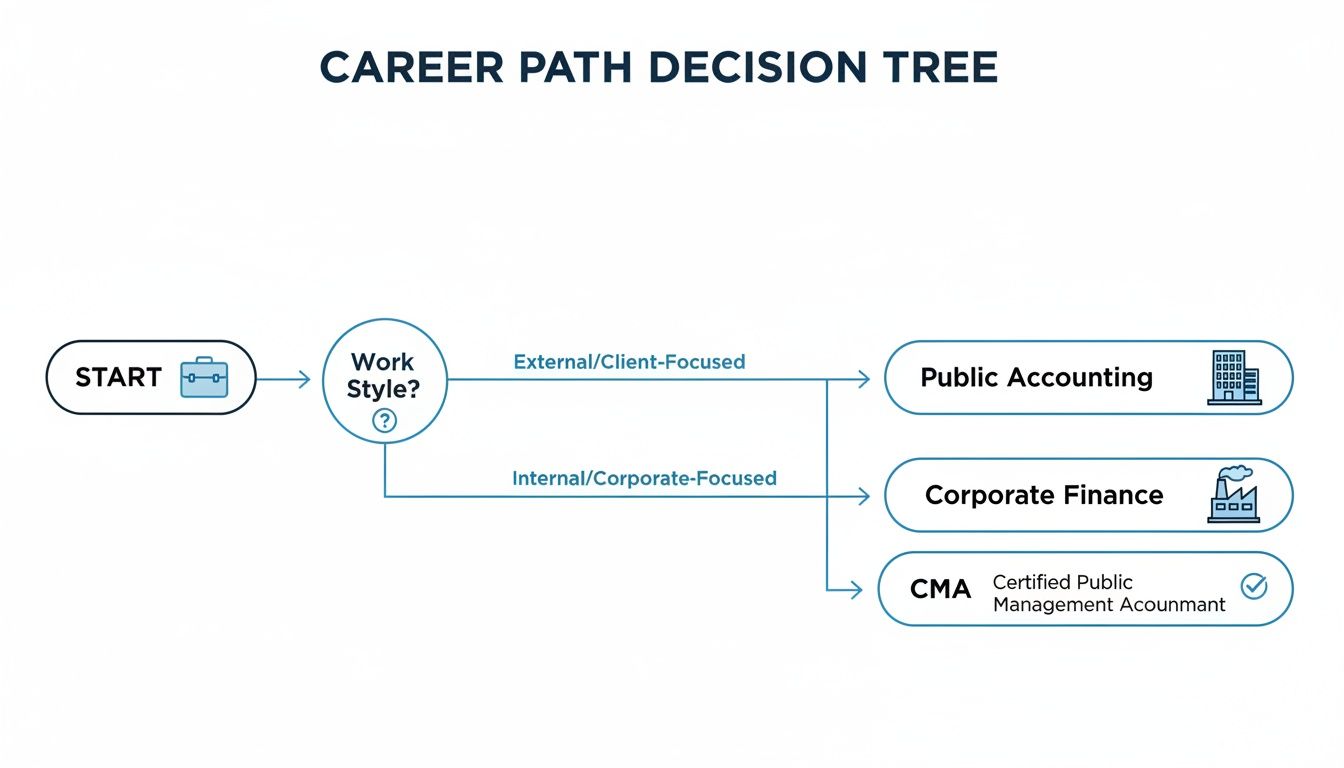
As you can see, if your compass is pointing toward public accounting and audit, the CPA is your most direct route. But if you see yourself shaping strategy from within a company, the CMA is your ticket.
Your Career Goal is the Deciding Factor
Let’s put this into real-world scenarios that we see every day with our students. You'll probably find yourself in one of these shoes.
Scenario 1: The Big 4 Aspirant in India
You're a recent graduate in India, and your dream is to land a fast-track audit career at a Big 4 firm. In this case, the CPA (USA) gives you an undeniable edge. These firms handle global clients, many based in the U.S., who live and breathe US GAAP. A CPA credential makes you an immediate asset, plain and simple. It’s your shortest path to high-profile audit work.Scenario 2: The Future Corporate Leader in the Gulf
Picture this: you're a working professional in a large manufacturing firm in Saudi Arabia or the UAE. You want to climb from a standard accounting role into a management position where you actually influence business decisions. Here, the CMA (USA) delivers the exact toolkit you need—cost management, performance analytics, and strategic financial planning. It’s the qualification that turns you from a number-cruncher into a genuine business partner to the C-suite.
Making the Right Choice for Your Situation
The debate over CPA vs CMA gets even clearer when we talk about salary and mobility. In India, career versatility often tips in favour of the CPA for public practice and global roles. On the other hand, the CMA is the king of corporate strategy.
Data shows that experienced CPAs can see their salaries climb to ₹25 lakhs faster, while the CMA average sits around ₹10-15 lakhs. A fresher with a CMA (USA) might start at ₹5-7 lakhs but can reach ₹25 lakhs with experience in senior corporate finance roles. You can dig into more salary details in this Indian salary comparison on BajajFinserv.in.
The most important question to ask yourself is this: "What kind of problems do I want to solve?" Do you want to ensure financial integrity for outside stakeholders (CPA), or do you want to drive internal profit and growth (CMA)? Your answer is your guide.
This is the kind of crystal-clear thinking our Chief Tutor, Mr. Padmanaban, brings to every class. With his 30+ years of experience, he personally mentors our students, helping them see beyond the exam to build a career that truly fits. Having guided over 10,000+ students, his founder-led expertise provides a deep understanding of the unique challenges professionals in the Gulf and India face.
For those of you juggling demanding jobs, our "Study Anytime/Anywhere" ecosystem is a lifesaver. Our Mobile App is packed with 300+ lecture hours, 4000+ MCQs, and 1500+ solved problems. With daily class recordings uploaded for you, it’s the ultimate tool for exam success on your own terms, no matter your time zone or work schedule.
Your Top Questions, Answered
Deciding between the CPA vs CMA is a big step, and I know you've got questions. As a mentor who has guided countless professionals through this, especially those in India and the Gulf, here are some straight answers to the most common queries I hear.
Can I Really Prepare for These Exams While Working Full-Time?
Yes, you absolutely can. In fact, most candidates do. Both the CPA and CMA are built for working professionals, but your exam success comes down to two things: a rock-solid study plan and learning materials that fit your life.
This is exactly why we built the "Study Anytime/Anywhere" ecosystem. Our Mobile App isn't just an afterthought; it’s a complete learning ecosystem with daily recorded lectures and a massive question bank. It’s perfect for professionals in India and the Gulf who need to turn a commute or a lunch break into a productive study session.
Which is Better for Jobs in the UAE and Saudi Arabia?
Both certifications are gold standards in the Gulf, but the "better" one really depends on where you want to work. Think of it this way:
- The CPA is your ticket into financial services, banking, and especially the Big 4 firms. Their world revolves around audit, compliance, and financial reporting—all core CPA strengths.
- The CMA is king in manufacturing, construction, oil and gas, and the finance departments of large corporations. These industries are all about strategic management, cost control, and performance analytics, which is the CMA's bread and butter.
Bottom line? Either one will open doors across the Middle East. Just make sure you pick the one that aligns with the industry you’re targeting.
Will My Indian B.Com Degree Be Enough for the CPA Exam?
This is a huge question for many Indian aspirants, and the answer is a bit nuanced. A typical Indian B.Com degree gives you 90-120 of the 150 credit hours needed for the full CPA license. The good news is that many U.S. states let you sit for the exam with just 120 credits.
So, how do you bridge the gap? Many students pursue a master's degree or use other professional qualifications to meet the full requirement. It sounds complicated, but it's a very common path and completely manageable with the right advice.
At Stride Edutech, this is where our Chief Tutor, Mr. Padmanaban, steps in. With his 30+ years of experience, he personally mentors students on these eligibility puzzles, creating a clear, step-by-step roadmap to get you exam-ready. This founder-led expertise ensures you get the concept clarity needed for success.
How Do I Get Access to the Stride Edutech Mobile App?
Our Mobile App is your secret weapon for passing these tough exams. It's packed with over 300+ lecture hours, 4000+ MCQs, and 1500+ solved problems, all designed for maximum flexibility.
It's completely free for all enrolled students. If you'd rather self-study using our materials, you also have the option to purchase the app separately. With over 10,000+ students guided to success, we know our tools work.
Ready to stop wondering and start preparing? At Stride Edutech, we give you the structure, expert guidance, and flexible tools you need to pass your exams and build the career you deserve.