
So, you're considering the Certified Management Accountant (CMA) qualification. That’s a smart move, especially for finance professionals in India and the Gulf looking for a serious career boost. The journey boils down to three key stages: getting your eligibility confirmed by the IMA, cracking the two-part exam, and then getting the required work experience under your belt.
Your Path to Becoming a CMA Starts Here
Earning your Certified Management Accountant credential isn't just about adding another line to your CV; it's a strategic investment in your future. This guide is your personal roadmap, designed to walk you through every single step—from checking the prerequisites to acing the exam and finally, holding that certificate. We're here to cut through the jargon and give you practical advice that works, especially if you're a working professional juggling a demanding job with a tough study schedule.
This isn't just a generic checklist. It's a game plan built from our experience of successfully training over 10,000+ students. Our philosophy is simple: exam success comes from true concept clarity, not just memorisation. This visual breaks down the process into three straightforward phases.
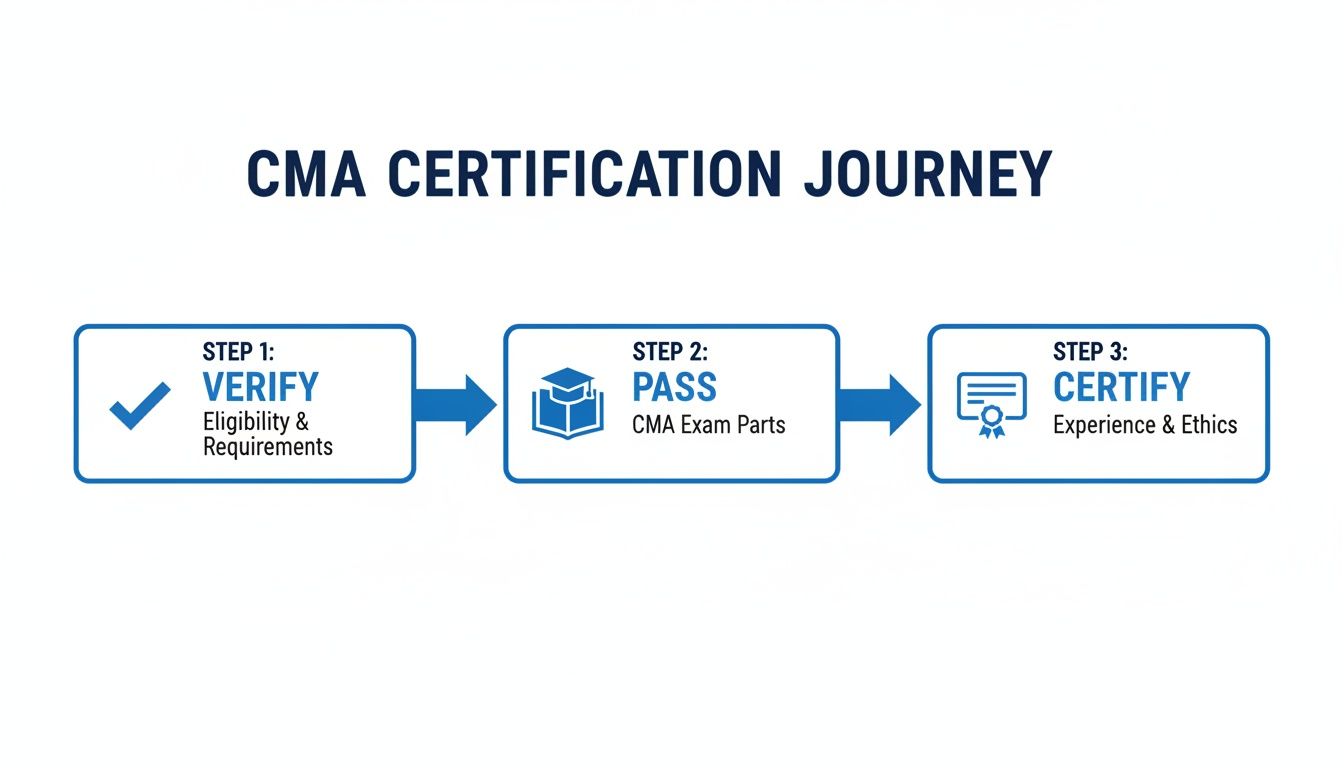
The journey is a clear, step-by-step process. You start with the basics, conquer the exams, and finish with your official certification. Here at Stride Edutech, we know that the right mentorship and real flexibility are what make all the difference.
Founder-Led Expertise: A Mentor-Led Approach to Success
You can't just memorise your way through the CMA USA syllabus. To truly master it, you need to understand the 'why' behind every formula and theory. That's where our founder-led coaching comes in.
Every single course is personally mentored by our Chief Tutor, Mr. Padmanaban, who brings 30+ years of experience to the table. His direct involvement ensures you get consistent, high-quality teaching that turns complicated topics into principles you can actually understand and apply. He personally mentors all courses, guaranteeing an expert guide for every student on their journey to exam success.
The "Study Anytime/Anywhere" Ecosystem: The Power of Flexible Learning
Let’s be honest—for working professionals in India, and especially in the Gulf/Middle East (UAE, Saudi Arabia, Oman, Kuwait, Qatar, Bahrain), time is the biggest hurdle. Conflicting work shifts and tricky time zones can make attending live classes feel impossible. We get it.
That’s why we built our "Study Anytime/Anywhere" ecosystem, powered by the Stride Edutech Mobile App. We upload daily class recordings right to the app, allowing Gulf students and professionals to catch up on lectures at their own convenience, regardless of time zones or work shifts. Think of it as a complete learning hub right in your pocket, packed with:
- Over 300+ lecture hours of in-depth video lectures.
- More than 4000+ MCQs to sharpen your speed and accuracy.
- 1500+ solved problems to ensure concept clarity sticks.
The Mobile App is free for all our enrolled students and also available for separate purchase. This mix of expert mentorship and on-demand tech gives you total control over your study schedule, setting you up to walk into the exam with confidence. To get the full picture of the qualification, you can learn more about the CMA USA course on our website.
Before you even think about cracking open a textbook or creating a study schedule, let's start at the most logical place: are you eligible for the CMA USA certification? This isn't just a box-ticking exercise. It's about making sure your hard work and dedication are pointed in the right direction from day one, aligning with the standards set by the Institute of Management Accountants (IMA).
Think of your journey to becoming a CMA as having two foundational pillars: your education and your professional experience. The basic requirements are straightforward—you need a bachelor's degree from an accredited university and an active IMA membership to even sit for the exams. But to get that coveted certificate after you pass, you'll also need to show two continuous years of relevant professional experience.

Now, that experience requirement often makes people pause. But here’s the good news: the IMA is incredibly flexible. You can gain this experience before, during, or even up to seven years after you’ve passed the exams. This is a massive advantage for students and young professionals in India and the Gulf, as it lets you get the tough part—the exams—out of the way first.
The Must-Haves: Education and Professional Prerequisites
Let’s get into the specifics of what the IMA expects. These are non-negotiable, so it’s smart to confirm you’ve got them covered before you invest your time and money.
- An Active IMA Membership: This is your key to the door. You need to be a member in good standing to register for the exams and must maintain it throughout your certification process.
- A Bachelor's Degree: You’ll need a degree from an accredited college or university. What's great is that your degree doesn't have to be in accounting or commerce. This opens up the CMA pathway to a huge range of professionals looking to pivot into finance.
- Two Years of Professional Experience: This is where the "management" part of management accounting comes in. You need two straight years of work in management accounting or financial management. This could include roles focused on financial analysis, budgeting, cost management, or providing data to support strategic decisions.
If you're just starting out, be strategic. Look for internships or entry-level roles in Financial Planning & Analysis (FP&A) departments. This is the perfect way to rack up qualifying experience while you’re studying.
"Many aspiring CMAs in the Gulf are surprised to learn their current finance or accounting roles already tick the box for the IMA's experience criteria. The trick is to clearly document how your daily tasks involve analysis and strategic financial input, not just routine bookkeeping."
CMA USA vs CMA India: Choosing Your Path
For finance professionals in India, a big question often pops up: should I go for the CMA USA or the home-grown CMA India certification? The right answer comes down to one thing: your career ambition.
If your sights are set on working for a multinational corporation (MNC) or building a career abroad, especially in the Middle East, the CMA USA is the clear winner. Its curriculum is built around international financial standards and strategic practices, earning it major respect from global employers. It’s designed to sharpen your decision-making skills for a leadership role, no matter where in the world you are.
CMA USA vs CMA India At a Glance
Making the right choice between these two respected certifications is crucial. While both focus on management accounting, they serve different career trajectories. This table breaks down the key differences to help you decide which path aligns better with your long-term goals.
| Attribute | CMA USA (Certified Management Accountant) | CMA India (Cost and Management Accountant) |
|---|---|---|
| Issuing Body | Institute of Management Accountants (IMA), USA | Institute of Cost Accountants of India (ICAI) |
| Global Recognition | Highly recognised globally, especially in the US, Middle East, and by MNCs. | Primarily recognised within India, with some acceptance in the Gulf region. |
| Exam Structure | Two parts (can be taken in any order). | Three levels: Foundation, Intermediate, and Final. |
| Average Duration | 12-18 months on average. | 3-4 years on average. |
| Focus | Strategic management, decision-making, financial planning, and analysis. | Strong focus on cost management, auditing, and Indian regulations. |
| Ideal For | Professionals seeking global mobility, roles in MNCs, and careers in the Gulf. | Professionals planning to build a long-term career within the Indian market. |
Ultimately, if you're aiming for a career that crosses borders, the CMA USA provides the global language of business that employers are looking for.
For a more detailed breakdown, have a look at our complete guide on CMA USA eligibility requirements for candidates in India and the Gulf. Getting this foundational knowledge right will ensure you pick the certification that truly serves your future.
Alright, you’ve confirmed your eligibility and joined the Institute of Management Accountants (IMA)—fantastic! That’s the first big step out of the way. Now, let’s tackle the practical side of things: registering for the exam, handling the fees, and booking your test day.
Getting these logistics sorted out early is key. It lets you clear your mind and focus completely on your studies, without any last-minute stress.
The whole process involves a couple of payments. First up is the CMA entrance fee. Think of this as your official entry ticket into the CMA programme. Once you pay it, the clock starts: you have three years to pass both parts of the exam. After that, you'll pay for each exam part as you're ready to take it.
A Clear Breakdown of Your Investment
Good financial planning is what management accounting is all about, so let's start with your own budget. Knowing the costs upfront means no nasty surprises down the road.
For a professional candidate, here’s what the investment looks like:
- IMA Membership Fee: This is an annual payment to keep your IMA status active. For professionals, it's currently $295.
- CMA Entrance Fee: A one-time fee of $300 for professionals that officially enrols you in the CMA programme.
- CMA Exam Fee: You’ll pay this for each exam part. It costs $545 per part, so the total for both comes to $1090.
Keep in mind, these are the standard fees. If you need to retake a part, you’ll have to pay that exam fee again. This is exactly why passing on the first attempt is so important.
At Stride Edutech, we're all about getting you exam-ready the first time. Our founder-led mentorship, backed by Mr. Padmanaban's 30+ years of experience, is designed to give you true concept clarity. We don't just teach you to memorise; we make sure you understand.
Choosing Your Testing Window and Scheduling the Exam
The CMA USA exam isn’t offered year-round. Instead, it runs during three specific testing windows, which gives you the flexibility to plan your prep around your life and work.
The windows are:
- January and February
- May and June
- September and October
Once you've paid your exam fee, you’ll get an authorisation number. Use this number to book your exam slot at a Prometric test centre.
Now, a crucial piece of advice for candidates in India and the Gulf: book your exam slot early! These centres have limited seats, and they fill up incredibly fast, especially as the end of a testing window approaches.
Putting off scheduling is a common mistake that can force you to travel to another city or, worse, miss your window entirely. We always tell our students to book their Prometric date at least four to six weeks in advance. It’s a simple step that eliminates a huge source of anxiety, freeing you up to focus on your final revision.
Having guided over 10,000+ students, we know these small practical steps make a huge difference. Our goal is to handle the noise so you can focus on what really matters—mastering the material.
Building a Study Plan That Actually Works for Professionals
Juggling a full-time career while aiming for the CMA USA certification is a marathon, not a sprint. Let's be honest, a random, "I'll study when I can" approach just won't cut it. To succeed, you need a smart, sustainable study plan that fits into your life without causing burnout.
A realistic timeline is your greatest asset. For most working professionals, whether you're in India or the Gulf, setting aside three to four months for each of the two parts is a solid, achievable goal. This breaks down to about 15-20 hours of study per week—enough to make real progress without sacrificing your sanity. This isn't about last-minute cramming; it's about building a deep, lasting understanding of the material.
Breaking Down the CMA Syllabus
The CMA USA curriculum is cleverly split into two parts. They're distinct, but they absolutely talk to each other. Your study plan needs to give each one the respect and time it deserves.
Part 1: Financial Planning, Performance, and Analytics: Think of this as the operational heart of management accounting. It covers everything from external financial reporting and budgeting to cost management, internal controls, and the ever-important role of technology and analytics.
Part 2: Strategic Financial Management: This is where you zoom out and put on your strategist hat. You'll dive into high-level topics like financial statement analysis, corporate finance, decision analysis, risk management, and professional ethics.
The secret to acing both parts isn't just memorising formulas. It's about getting true concept clarity. You need to understand the why behind every calculation and principle. This is where rote learning hits a wall, and where genuine, expert mentorship becomes a game-changer.
Why Mentorship is Your Secret Weapon for Concept Clarity
You can read a textbook ten times, but if a core concept just isn't clicking, you’re stuck. That's precisely why our coaching philosophy at Stride Edutech revolves around direct mentorship from our Chief Tutor, Mr. Padmanaban. With 30+ years of teaching experience, he personally guides every course, making sure each student gets the benefit of his deep expertise.
His method is simple but powerful: break down complex topics into bite-sized, logical pieces. He doesn’t just show you a formula; he explains its real-world business application, training you to think like a strategic finance professional. It’s this deep-seated understanding that separates first-time passers from those who have to re-sit the exam.
"The CMA exam isn't a test of memory; it's a test of application. Our goal is to equip you with such a strong conceptual foundation that you can confidently solve any problem thrown at you on exam day, because you understand the underlying principles, not just the steps."
This focus on clarity is crucial, especially when you look at the numbers. The CMA USA is a tough exam, with global pass rates historically hovering around 45%. While Part 1 rates have thankfully climbed from 35% (pre-2020) to a more stable 45% recently, Part 2 consistently sees pass rates between 45–50%. The good news? Coached Indian candidates often beat these averages, hitting 45–55% in Part 1 and 50–60% in Part 2. This just goes to show how much of a difference structured preparation can make.
Your Study Anytime, Anywhere Ecosystem
For working professionals, a rigid study schedule is a recipe for failure. Meetings run late, deadlines pop up, and life happens. This is especially true for our students in the Gulf, who often deal with varied work shifts and time zones.
That’s where our "Study Anytime/Anywhere" ecosystem, powered by the Stride Edutech Mobile App, makes all the difference.
We know you can't always make a live class. That's why every single session is recorded and uploaded directly to the app. This means you can catch up on a lecture during your commute, review a tough topic late at night, or squeeze in some MCQ practice on your lunch break. The power to learn is literally in your pocket, on your schedule.
But the app is so much more than a video library. It’s a complete learning hub, free for all our students, packed with:
- 300+ lecture hours covering the entire syllabus, in-depth.
- 4000+ MCQs to sharpen your skills and build exam-day speed.
- 1500+ solved problems that walk you through how to tackle complex scenarios.
This unique blend of founder-led mentorship and a flexible digital platform gives you the support and resources you need to build a study plan that actually works with your life. For a deeper dive into scheduling, check out our guide on how to create a 6-month CMA USA study plan.
Mastering the CMA Exam Format and Question Types
Knowing the syllabus is only half the battle. To really come out on top, you need a solid exam-day strategy, and that starts with understanding the structure of the CMA USA exam. Think of it as a test of knowledge, endurance, and sharp time management all rolled into one. Being ready for the format is just as critical as knowing the content inside and out.
Both Part 1 and Part 2 of the exam follow the exact same blueprint. You’re looking at a four-hour test, split into two distinct sections.
You’ll kick things off with a three-hour segment packed with 100 multiple-choice questions (MCQs). After you wrap that up, you move into the second section: two 30-minute essay scenarios.

Here's the crucial part: you can't jump back and forth between sections. Once you submit the MCQs and start the essays, the door to the first section is locked for good. This design forces you to have a clear, two-pronged approach for both your prep and your performance on the day.
Decoding the Exam Weighting and Strategy
The exam is heavily tilted towards the multiple-choice questions. The MCQs make up a whopping 75% of your total score, with the two essays accounting for the final 25%. But there's a catch—a gatekeeper rule you absolutely must know.
To even get a shot at the essay section, you have to answer at least 50% of the MCQs correctly. If you don't hit this mark, your exam ends right there, and it's an automatic fail for that part. This rule alone tells you how important it is to have a rock-solid grasp of the core concepts tested in the MCQs.
This is where relentless practice becomes your best friend. At Stride Edutech, we've seen it time and again: repeated exposure to exam-style questions is what builds the confidence and speed you need. It’s about getting a feel for how questions are worded and training your brain to spot the right answer among tricky options.
"True exam success is born from deep concept clarity, not just memorisation. When you understand the 'why' behind a principle, you can tackle any MCQ, no matter how it's phrased. This is the core philosophy our Chief Tutor, Mr. Padmanaban, brings to every class with his 30+ years of experience."
A Tactical Approach to Multiple-Choice Questions
With 100 questions to get through in three hours, you’ve got about 1.8 minutes per question. This means you have to be ruthlessly efficient. Getting stuck on one tough question is not an option.
Here’s a proven strategy for navigating the MCQ section:
- Bank the Easy Wins: Scan through and answer all the questions you're 100% sure about first. This builds momentum and gets easy points on the board.
- Flag and Return: If a question stumps you or looks like it needs a long calculation, flag it and move on. Don’t let one question eat up the time you need for the next ten.
- Process of Elimination is Your Friend: For the tougher ones, start by knocking out the answer choices you know are wrong. This dramatically improves your odds if you have to make an educated guess.
- Never Leave a Question Blank: There’s no negative marking in the CMA exam. A guess is always, always better than leaving an answer empty.
Structuring Your Essays for Maximum Impact
The essay section isn't about writing flowery prose. It's about showing you can apply what you know and communicate your analysis clearly. Each of the two scenarios will have a few smaller questions that need written answers.
A simple but highly effective way to structure your answers is to first identify the problem, then explain the relevant accounting principle, and finally, apply it to the scenario to draw your conclusion. Use bullet points or short, punchy paragraphs to keep your answer organised and easy for the grader to read. And don't forget to show your work—partial credit is often given for correct calculations, even if the final answer is off.
This is where practice really does make perfect. The Stride Edutech Mobile App is designed to build this exact 'exam muscle'. It’s an essential tool that our 10,000+ successful students, especially busy professionals in India and the Gulf, rely on.
The app's massive question bank lets you simulate real exam conditions anytime, anywhere:
- Over 4000+ MCQs to help you master speed and accuracy.
- More than 1500+ solved problems that break down the logic behind complex essay-style scenarios.
This "Study Anytime/Anywhere" ecosystem ensures you can turn any spare moment—whether it's on your commute or during a lunch break—into a productive study session. It’s how you walk into the exam centre feeling completely prepared for whatever comes your way.
You've done it. You’ve passed both parts of the CMA USA exam. That’s a huge achievement and a real test of your commitment. But this isn't the finish line. Think of it as the starting line for the next, most exciting part of your career.
Now it's time to make it official and get the full power of your new credential. You’ll need to send the IMA your university transcripts and get your employer to validate your two years of hands-on experience in management accounting or financial management. Once the IMA gives the green light, you are officially a Certified Management Accountant.
Unlocking a World of Opportunity in India and the Gulf
With that certificate in hand, your career landscape completely changes. The CMA USA isn't just another qualification; it's a globally recognised badge of excellence. It opens doors to strategic roles that go way beyond typical accounting.
Especially in the competitive job markets of India and the Middle East, it tells employers you have the high-level skills they’re looking for—business analysis, strategic planning, and financial leadership.
This puts you in the running for some seriously influential positions. Companies are constantly on the lookout for CMAs to fill roles like:
- Financial Analyst: Getting into the data to steer investment decisions and company strategy.
- Cost Accountant/Manager: Becoming a master of cost control and making operations more efficient.
- Corporate Controller: Running the entire accounting show and making sure everything is financially sound.
- Finance Manager: Leading finance teams and shaping the company’s financial roadmap.
- Chief Financial Officer (CFO): The top spot in strategic finance, guiding the entire organisation’s financial destiny.
At Stride Edutech, our goal was never just to help you pass an exam. We’ve mentored over 10,000+ students, and our focus has always been on building deep concept clarity. This is what stays with you for your entire career, turning your certificate into real, long-term success.
This isn’t just about fancy titles. It’s about a major financial return on your investment. The career growth for CMAs in India is impressive. Recent data shows that CMAs with 3–6 years of experience are earning packages between ₹10–18 LPA.
As you gain more experience, that number climbs fast. Senior-level CMAs with 7–10+ years of experience often earn between ₹22–40 LPA+ in roles like Finance Manager or Controller. For those on the leadership track with 15+ years of experience, positions like CFO or Director of Finance can command salaries from ₹60 Lakhs to ₹1.5 Crores. Want to see more? Check out the numbers in this detailed 2026 salary guide.
Your Partner in Long-Term Career Success
At Stride Edutech, our commitment to you doesn't end when the exam does. This philosophy comes directly from our Chief Tutor, Mr. Padmanaban, and his 30+ years of experience. We want you to truly understand the material, not just memorise it. That deep understanding is what you’ll use every day in the real world.
We know that for working professionals, especially our students in the Gulf with demanding schedules, learning has to be flexible. Our "Study Anytime/Anywhere" approach is built for this. The Mobile App you used for studying is still a valuable tool. It’s a library you can always come back to.
These resources are free for our enrolled students, even after you've passed:
- 300+ lecture hours to refresh key concepts.
- 4000+ MCQs and 1500+ solved problems to keep your skills razor-sharp.
Your journey on how to become a certified management accountant reaches its most rewarding stage now. With your new credential and the solid foundation you’ve built, you are perfectly placed to not just compete, but to lead in a global market.
Got Questions About the CMA Journey? We've Got Answers

Embarking on the path to how to become a certified management accountant is a big move, and it’s natural to have questions. We hear a lot of the same queries from aspiring CMAs in India and the Gulf.
Let's clear up some of the most common ones so you can move forward with confidence.
Can I Pursue CMA USA Without a Commerce Degree?
Yes, you absolutely can. This is a common myth we need to bust!
The IMA requires a bachelor's degree from an accredited university, but it doesn't specify the field. So whether you studied engineering, arts, or science, the door is open. As long as you meet the educational and professional experience criteria, your academic background isn't a roadblock.
That said, a solid grasp of accounting and finance is non-negotiable for exam success. If you're coming from a non-commerce background, high-quality coaching isn't just helpful—it's essential. It ensures you build the concept clarity needed to not just pass, but to truly master the material.
How Long Does the Entire CMA Certification Process Take?
There are a couple of timelines to consider here.
Most candidates we work with manage to clear both parts of the exam within 12 to 18 months. The IMA officially gives you three years to pass both parts after you pay the entrance fee, which is a generous window.
The final certification, however, also hinges on completing the two-year professional experience requirement. The great thing is you can clock this experience before, during, or even within seven years of passing your exams.
What Is the Core Difference Between a CMA and a CPA?
It all boils down to focus. Think of it this way: a CPA looks outward, while a CMA looks inward.
A CPA (Certified Public Accountant) is primarily concerned with public accounting. Their world revolves around external audits, tax filings, and ensuring compliance with regulations for outside stakeholders.
In contrast, a CMA USA is the strategic financial expert within an organisation. They are the ones driving internal decision-making. Their work involves budgeting, financial planning, performance analysis, and providing the insights management needs to run the business more effectively from the inside out.
Your journey to becoming a CMA is a significant investment in your professional future. At Stride Edutech, our founder-led mentorship and flexible "Study Anytime/Anywhere" ecosystem, powered by our Mobile App, are designed to guide you every step of the way.
Ready to start your path with expert mentorship that makes a real difference?