
In the world of corporate finance, consolidation in accounting is the process of bringing together the financial statements of a parent company and all its subsidiaries into one single, unified report. Achieving concept clarity on this topic is a major step toward exam success.
Think of it like creating one clear financial story for an entire corporate family, rather than trying to understand each member's accounts separately. This combined report gives investors, regulators, and management a true picture of the whole group's financial health, treating it as if it were a single economic entity.
What Is Consolidation In Accounting?
Imagine a large, successful company decides to buy a smaller, specialised firm to expand its product line. Legally, they remain two distinct companies. But in economic reality, they're now one team working towards the same goals. How do you accurately report their combined financial muscle and performance? This is exactly the problem that consolidation solves.
The process involves adding up all the assets, liabilities, equity, income, and expenses of the parent and its subsidiaries. But here's the crucial part: it also requires eliminating any transactions that happened between these companies. If the parent sold goods to its subsidiary, that internal sale is cancelled out to avoid artificially inflating the group's total revenue. The final result is a single set of consolidated financial statements that offers a complete, holistic view.

Why Is Consolidation A Core Concept For Your Exams?
Mastering consolidation isn’t just an academic exercise; it’s a non-negotiable requirement under global accounting standards. This practice became especially critical in India with the adoption of Ind AS 110 in 2016, which aligns with IFRS 10 and makes consolidation mandatory for any company that controls another.
The real-world impact is massive. For example, after the recent wave of consolidations in India's public sector banking space, data from the Reserve Bank of India (RBI) showed the total assets of the top five PSBs jumped by over 40% between 2019 and 2023. You can read more about the effects of industry consolidation in India on Wellington.com.
For students gearing up for exams like CMA USA, ACCA, or CA, a deep understanding of consolidation is an absolute must. It's a favourite topic for examiners because it tests your ability to apply complex rules to practical, real-world business scenarios.
At Stride Edutech, we know that concept clarity is the bedrock of exam success. Our Chief Tutor, Mr. Padmanaban, with over 30+ years of experience, personally mentors every course to ensure you don't just memorise rules but truly grasp the concepts. Our "Study Anytime/Anywhere" ecosystem, powered by our Mobile App, is built for busy professionals in India and the Gulf. With daily class recordings and a rich library of resources, you can master tough topics like consolidation at your own pace. Join the 10,000+ students we've successfully trained and build the strong conceptual foundation you need to ace your exams.
The Three Core Consolidation Methods Explained
To really get to grips with what consolidation in accounting is, you need to move past the ‘why’ and master the ‘how’. For your professional exams, this means knowing the three main methods like the back of your hand. Examiners love to test whether you can pick the right one based on how much influence a parent company has over another entity.
Think of it this way: your relationship with someone dictates how you interact with them. You treat a close family member differently than a business partner or a casual acquaintance. In the same way, the percentage of ownership and control determines which accounting method you must use.
Nailing this isn't just about passing an exam; it's a vital skill for professionals working in fast-paced financial hubs like the UAE and Saudi Arabia, where complex corporate structures are the norm.
The Full Consolidation Method: Control Is Key
The Full Consolidation method is the big one. It’s used when a parent company has control over a subsidiary, which is usually the case when it owns more than 50% of the subsidiary's voting shares.
With this method, you combine 100% of the subsidiary's assets and liabilities with the parent's, line by line. It doesn't matter if the parent owns 60% or 95%—you bring in the full amounts to show the total resources the parent controls.
- Trigger: Owning over 50% of voting stock, which gives the parent company control.
- Financial Statement Impact: All assets and liabilities of the subsidiary are added to the parent's balance sheet.
- Key Concept: The part of the subsidiary's equity that the parent doesn't own is shown separately as Non-Controlling Interest (NCI). This clever step ensures the balance sheet still balances.
This method gives you the clearest, most complete picture of the economic group's true size and reach.
The Equity Method: Significant Influence Without Control
So, what happens when a company has a major say in another's operations but doesn't have the final word? That’s where the Equity Method steps in. You use this when an investor has significant influence over an associate, typically shown by an ownership stake of 20% to 50%.
Instead of mixing all assets and liabilities together, the investment is shown as a single line item on the investor's balance sheet. This investment account is then adjusted each year.
The core idea of the equity method is that the investment's value on your books should reflect your share of the associate's changing net worth. If they make a profit, your investment value goes up. If they declare a dividend, it comes down.
The investment starts at cost. From there, it’s increased by the investor's share of the associate's profit and reduced by any dividends received. For a deeper dive into how consolidation topics are weighted, you might be interested in our guide on the ACCA syllabus breakdown.
Proportionate Consolidation: For Joint Ventures
While it’s less common under modern IFRS and Ind AS standards, understanding Proportionate Consolidation is still worthwhile. This method was historically the go-to for joint ventures, where two or more parties share joint control over a business activity.
Instead of combining 100% of the assets and liabilities (like in full consolidation), the venturer only includes its proportionate share. If your company owns 50% of a joint venture, you would simply add 50% of its cash, 50% of its inventory, 50% of its debt, and so on, to your own financial statements.
Mastering these methods takes practice and clear guidance. This is where the founder-led expertise of our Chief Tutor, Mr. Padmanaban, becomes so valuable. With 30+ years of experience, he personally mentors all our courses, making sure every one of the 10,000+ students we've trained receives consistent, top-quality teaching.
For professionals juggling work and studies, our Stride Edutech Mobile App offers the ultimate flexibility. It’s a "Study Anytime/Anywhere" ecosystem where daily class recordings, 300+ lecture hours, 4000+ MCQs, and 1500+ solved problems are available on demand, helping you master complex topics at your own pace.
Your Step-By-Step Guide To The Consolidation Process
Moving from theory to practice is where you really start to master consolidation. It's one thing to understand the methods, but it's a completely different challenge to execute the process correctly when the exam clock is ticking. This guide breaks down the entire procedure into a clear, step-by-step workflow, mirroring the practical, hands-on teaching style personally mentored by our Chief Tutor, Mr. Padmanaban.
With over 30+ years of experience, he makes sure every student masters the how and the why, not just memorising the theory. This approach builds the confidence you need to tackle even the most complex exam problems. Let's walk through the key stages together.
The image below gives you a quick visual of how ownership percentages determine which consolidation method to use. Getting this first step right is absolutely crucial.
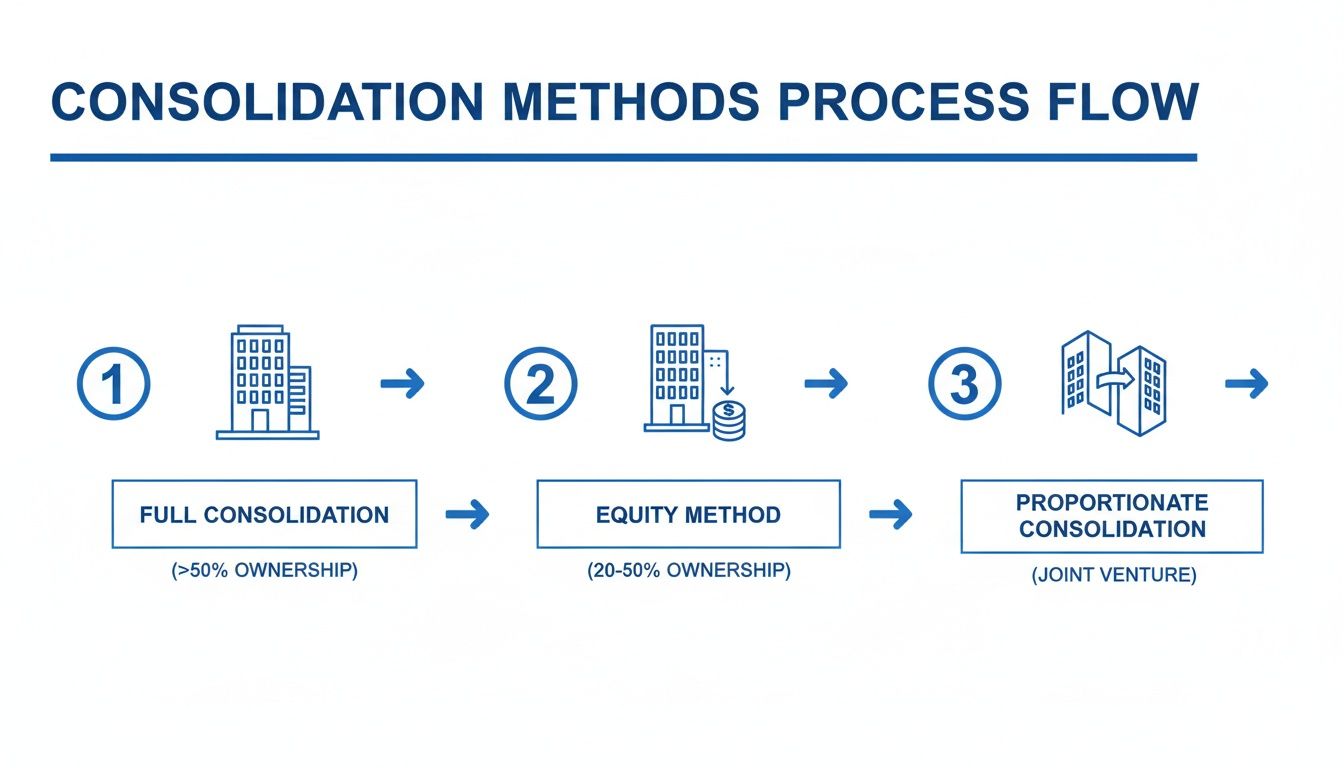
This visual should serve as a mental checklist: your first action is always to assess the level of control or influence before you do anything else.
Step 1: Identify The Parent-Subsidiary Relationship
Before a single number gets combined, you have to confirm that a control relationship actually exists. This is usually pretty straightforward—if a parent company owns more than 50% of a subsidiary's voting shares, you've got control.
But be warned: exam questions love to test your understanding of 'de facto' control. This is where control can exist even with less than 50% ownership because of other factors like board representation or contractual agreements. Always start by documenting the ownership structure and, critically, the date of acquisition. That date is the key to separating the subsidiary's pre-acquisition and post-acquisition profits, a vital piece of the puzzle for advanced problems.
Step 2: Combine The Financial Statements
Once you've confirmed control, the next step is simple aggregation. You’re going to combine the financial statements of the parent and subsidiary on a line-by-line basis. That means adding the subsidiary’s cash to the parent’s cash, their inventory to your inventory, their accounts payable to your accounts payable, and so on.
- Cash (Parent) + Cash (Subsidiary) = Consolidated Cash
- Property, Plant & Equipment (Parent) + PPE (Subsidiary) = Consolidated PPE
- Revenue (Parent) + Revenue (Subsidiary) = Consolidated Revenue
This straightforward addition exercise creates a preliminary, unadjusted consolidated statement. Think of it as the raw material that you’ll refine in the next, most important step.
Step 3: Make Consolidation Adjustments And Eliminations
This is the heart of the consolidation process and where most of the marks are won or lost in an exam. The goal here is to eliminate any transactions that happened between the parent and the subsidiary during the accounting period. Why? Because from the group's perspective, a company can't genuinely make a profit by selling to itself, nor can it owe itself money.
Think of it like this: if you move money from your right pocket to your left pocket, you haven't actually become any richer. Eliminating intercompany transactions ensures the consolidated financials only show transactions with the outside world.
Some of the most common eliminations you'll need to make are:
- Intercompany Sales and Purchases: If the parent sold goods to the subsidiary, you must eliminate the parent's revenue and the subsidiary's cost of goods sold from the consolidated statement.
- Intercompany Loans: A loan from the parent to the subsidiary is an asset for the parent and a liability for the subsidiary. For the group, it doesn't exist, so it has to be cancelled out.
- Unrealised Profits: This is a classic exam favourite. If the parent sold inventory to the subsidiary at a profit, and that inventory is still sitting in the subsidiary's warehouse at year-end, that profit is "unrealised." You must remove it from the consolidated inventory value and the group's retained earnings.
For instance, if Parent P sells goods costing ₹800 to Subsidiary S for ₹1,000, and S still holds these goods, there is an unrealised profit of ₹200. The consolidation journal entry would reduce both the closing inventory and the group’s profit by ₹200.
Getting comfortable with these journal entries is non-negotiable, and it’s a core focus of our teaching at Stride Edutech. For those preparing for advanced papers, these adjustments are absolutely fundamental. You can see how these topics fit into the broader curriculum by exploring the CA Intermediate New Syllabus for 2025.
Ultimately, this methodical process turns a daunting accounting challenge into a series of logical, manageable steps. For our students who are working professionals in the Gulf, practising these steps is easier than ever with our Mobile App. We upload daily class recordings, so you can review detailed examples and solved problems anytime, anywhere, fitting your studies perfectly around your work schedule. With access to over 300+ lecture hours and 1500+ solved problems, you can build the practical skills and confidence to ace your exams.
Mastering Goodwill And Non-Controlling Interest
Once you've got a solid handle on the core consolidation process, it's time to tackle two topics that trip up students in professional exams time and time again: Goodwill and Non-Controlling Interest (NCI). Getting these right isn't just about passing; it's about showing you have a deeper, more expert understanding of what consolidation truly means.
These concepts are what separate the top-tier candidates from the rest. Let's break them down so you can walk into your CMA USA and IFRS papers with total confidence.

Unpacking Goodwill In An Acquisition
Put simply, Goodwill is the premium a parent company pays to buy a subsidiary, over and above the fair value of its identifiable net assets.
Think of it this way: when you buy a company, you aren't just buying its buildings, machinery, and inventory. You're paying for its brand reputation, its loyal customer base, its skilled workforce, and its prime market position. These are incredibly valuable assets, but they're intangible—they don't sit neatly on a traditional balance sheet.
Goodwill is the accounting world's way of capturing that extra value. It’s an intangible asset that only ever appears during a business combination and is recorded on the consolidated balance sheet.
Goodwill represents the future economic benefits from assets that you can't identify individually or recognise separately. It’s the price you pay for a company's potential, not just what it owns today.
The calculation is pretty straightforward:
- Step 1: Figure out the purchase consideration (the total amount paid for the subsidiary).
- Step 2: Determine the fair value of the subsidiary's net assets (Assets minus Liabilities) on the date of acquisition.
- Step 3: Subtract the fair value of net assets from the purchase consideration. What's left is your Goodwill.
Calculating Goodwill: A Practical Example
Let’s say Parent Co. acquires 80% of Subsidiary Co. for ₹1,500,000. On the acquisition date, the fair value of Subsidiary Co.'s net assets is ₹1,600,000.
First, we need to figure out the total implied value of the subsidiary, not just the part Parent Co. bought.
- Purchase Consideration: ₹1,500,000 (for an 80% stake)
- Fair Value of NCI (the other 20%): Let's assume this is valued at ₹350,000.
- Total Implied Value (100%): ₹1,500,000 + ₹350,000 = ₹1,850,000
- Fair Value of Net Assets: ₹1,600,000
Now, we can calculate the Goodwill:
- Goodwill = Total Implied Value – Fair Value of Net Assets
- Goodwill = ₹1,850,000 – ₹1,600,000 = ₹250,000
This ₹250,000 is recorded as an intangible asset on the consolidated balance sheet.
Understanding Non-Controlling Interest (NCI)
When a parent company owns less than 100% of a subsidiary but still uses the full consolidation method, it has to account for the slice of the business it doesn't own. This portion of the subsidiary's equity belongs to the other, "minority" shareholders, and it's called Non-Controlling Interest (NCI).
Even though the parent consolidates 100% of the subsidiary's assets and liabilities, the NCI entry ensures that the parent’s claim on the subsidiary's equity is stated correctly.
- On the Balance Sheet: NCI is shown as a separate component within the equity section, distinct from the equity belonging to the parent's shareholders.
- On the Income Statement: The subsidiary's entire net income is included in the consolidated profit. Then, a line item deducts the portion of that profit that belongs to the NCI, leaving the final profit attributable to the parent company's owners.
Mastering these calculations takes practice. It’s the kind of hands-on work that our Chief Tutor, Mr. Padmanaban, has championed for over 30+ years. His experience is baked into our teaching philosophy, which is all about practical application. The Stride Edutech Mobile App is your perfect practice partner here, creating a "Study Anytime/Anywhere" ecosystem. For students in India and professionals across the Gulf, it’s a game-changer. With over 1500+ solved problems on the app, you can perfect these complex consolidation topics on your own schedule.
Navigating Global Standards: IFRS, Ind AS, and US GAAP
For anyone building a finance career in India or the Gulf today, being fluent in global accounting frameworks isn’t just a nice-to-have—it’s a career essential. The biggest multinational corporations and the Big 4 firms all operate across borders. This means your ability to navigate the subtle but critical differences between IFRS, Ind AS, and US GAAP is what sets you apart.
Getting these nuances right is a huge step towards passing your exams and achieving the concept clarity needed for a top-tier career.
At Stride Edutech, we build this global perspective into everything we do. Our Chief Tutor, Mr. Padmanaban, brings over 30+ years of hands-on experience to the table, personally mentoring every student. He makes sure our curriculum isn't just theory; it’s aligned with the latest global standards, preparing you for the real-world challenges of an international finance career.
Key Differences in Consolidation Rules
While the big picture of what is consolidation in accounting stays the same, the devil is in the details of how it's applied. Mastering these differences is what separates the average candidate from the exceptional one.
Defining 'Control': Under IFRS 10 and Ind AS 110, control is determined by a single, principles-based model. It boils down to three things: power over the investee, exposure to its variable returns, and the ability to use that power. US GAAP, on the other hand, is a bit more complicated. It uses a voting interest model for some cases and a more complex variable interest entity (VIE) model for others, which can sometimes lead to completely different consolidation outcomes.
Treatment of Goodwill: Here’s another major split. With IFRS and Ind AS, you don't amortise goodwill. Instead, you have to test it for impairment at least once a year. But under US GAAP, private companies have the option to amortise goodwill over a period of ten years or less. This creates a huge difference in reported profits and is a classic exam question area.
This is exactly where founder-led expertise makes all the difference. Mr. Padmanaban has a knack for cutting through the jargon and demystifying these complex rules, so you can confidently apply the right standard in any exam scenario. It’s this practical clarity that has already helped over 10,000+ students ace their exams. You can get a feel for our approach by checking out our comprehensive IFRS course details.
Presentation of Non-Controlling Interest (NCI)
The way Non-Controlling Interest (NCI) is shown on the financial statements is another point of divergence. While both IFRS and US GAAP agree that NCI belongs in the equity section of the consolidated balance sheet, there can be subtle differences in how comprehensive income attributable to NCI is presented.
Comparing Consolidation Rules: IFRS vs US GAAP
For students preparing for exams, knowing the key differences between IFRS and US GAAP for consolidation is non-negotiable. These are the areas examiners love to test. Here’s a quick comparison table to help you keep the main points straight.
| Aspect | IFRS / Ind AS | US GAAP |
|---|---|---|
| Defining Control | A single, principles-based model (IFRS 10 / Ind AS 110) focusing on power, returns, and the link between them. | Uses a dual model: a voting interest model and a separate, more complex variable interest entity (VIE) model. |
| Goodwill Treatment | Goodwill is not amortised. It must be tested for impairment annually. | Public companies test for impairment. Private companies have the option to amortise goodwill over 10 years or less. |
| NCI Presentation | NCI is always presented within the equity section. | NCI is presented within the equity section, but there can be subtle differences in how it's classified (e.g., as 'mezzanine' equity in some specific cases). |
| Contingent Consideration | Measured at fair value at the acquisition date, with subsequent changes in fair value recognised in profit or loss. | Subsequent changes in fair value are generally recognised in earnings, unless the contingency is classified as equity. |
This table covers the most common areas of difference you’ll encounter. Remembering these distinctions can easily earn you extra marks on exam day.
In India, the requirement for consolidation in accounting is deeply embedded in corporate law. It’s a core part of Schedule III of the Companies Act 2013, which makes consolidated financial statements mandatory for listed companies. India's push for transparency has a long history, with fiscal consolidation systems evolving since 1871. This drive intensified after the Rangarajan Commission in 2001 pointed out major gaps in corporate data, leading to reforms that now see over 1.2 million companies filing consolidated returns. You can read more about India's fiscal consolidation journey on CEICdata.com.
We know that for busy professionals in the Gulf, keeping up with these evolving global standards can be a challenge. That’s why our "Study Anytime/Anywhere" ecosystem, powered by our Mobile App, is so valuable. We upload daily class recordings, allowing you to master complex topics like IFRS vs. US GAAP differences on your own schedule, whether it's during your commute or late at night.
Your Path To Exam Success With Stride Edutech
Knowing the theory of what is consolidation in accounting is one thing, but acing the exam? That’s a whole different ball game. To get there, you need more than just a textbook; you need a partner who understands the journey and is committed to your exam success. At Stride Edutech, our mission is to turn complex accounting concepts into skills you can confidently use to pass your exams.
This isn’t just another training centre. Our courses are personally led and mentored by our Chief Tutor, Mr. Padmanaban, who brings over 30+ years of real-world experience into every single class. With this founder-led expertise, you get consistent, high-quality teaching that focuses on deep conceptual clarity, not just memorising formulas. It's an encouraging and authoritative approach that has already helped over 10,000+ students earn their certifications.
A Learning System Built Around Your Life
We get it. Many of our students are working professionals, especially those across the Gulf in the UAE, Saudi Arabia, Oman, and Qatar. Juggling a demanding career with intense study is tough. That’s why we designed our "Study Anytime/Anywhere" ecosystem, all powered by our state-of-the-art Mobile App.
Think of it as your classroom on the go. We upload daily class recordings, so you never have to stress about missing a lecture because of a late shift or timezone differences. You can catch up during your commute, on your lunch break, or late at night. Your study schedule is finally in your hands.
Our goal is simple: to provide an educational framework that adapts to your life, not the other way around. We empower you to learn on your terms, ensuring that your professional commitments and your academic ambitions can coexist and thrive.
The Stride Edutech Mobile App is loaded with everything you need to prepare thoroughly:
- 300+ Hours of In-Depth Lectures: We cover every single topic you need to master.
- 4000+ Multiple Choice Questions: The perfect tool to sharpen your knowledge and build exam-day speed.
- 1500+ Solved Problems: Get detailed, step-by-step solutions that actually make sense and reinforce what you’ve learned.
This powerful resource is free for all our enrolled students and can also be purchased separately. Join the thousands of successful professionals who trusted Stride Edutech to get them across the finish line. Take the next step in your certification journey with a partner who truly gets what you need to succeed.
Common Questions We Hear From Students
As you get to grips with consolidation, a few questions always pop up. It's completely normal—these are the tricky bits that often trip students up in exams. Let's clear up some of the most common points of confusion so you can tackle your studies with confidence.
Why Do We Bother Eliminating Intercompany Transactions?
Think of it this way: can you really make a profit by selling something from your left hand to your right hand? Of course not. From the perspective of a consolidated group, any sale or loan between a parent and its subsidiary is just an internal shuffle.
If we didn't eliminate these transactions, the group's financial statements would show inflated revenues, assets, and liabilities. It wouldn't be a true and fair picture of how the group actually performed with the outside world. Getting rid of these internal deals is a critical step to ensure the final numbers are honest and accurate.
What’s The Real Difference Between Consolidation And A Merger?
This is a classic exam question, and it's easy to get them mixed up. The distinction is actually quite simple.
- Consolidation is something you do over and over again. It's an accounting process where a parent and its subsidiaries, which are still separate legal companies, combine their financial reports at the end of every period. It’s like a family creating a single household budget—everyone still has their own bank account, but you're looking at the total picture.
- A Merger is a one-time legal event. Two or more companies legally fuse into a single new entity. The old companies literally cease to exist. Using our family analogy, this is like two families legally joining to become one household.
How Can I Possibly Study Consolidation While Working Full-Time?
We hear this all the time, especially from busy professionals in the Gulf. Juggling a demanding job with intense exam prep is a huge challenge. This is exactly why we built Stride Edutech around flexibility.
Our 'Study Anytime/Anywhere' model, powered by the Stride Edutech Mobile App, is the answer. We give you access to daily class recordings, so you can catch up on lectures, solve problems from our massive question banks, and review notes whenever you have a spare moment—whether it's on your commute or after the kids are in bed.
This approach means you never have to fall behind. You can manage your career and your studies without sacrificing either.
Is Goodwill Amortised Under Ind AS And IFRS?
The short answer is no. Under both Ind AS 103 and IFRS 3, goodwill from a business combination is not amortised each year like other assets.
Instead, you have to test it for impairment at least once a year (or more if there are red flags). If the goodwill's value has dropped, you record an impairment loss in the income statement. This is a massive difference from US GAAP, which sometimes allows private companies to amortise goodwill. Examiners love to test this point, so make sure you have it down cold!
Ready to turn your knowledge into exam success? At Stride Edutech, our founder-led expertise, with personal mentorship from our Chief Tutor, Mr. Padmanaban, has helped over 10,000 students achieve their career goals. Our "Study Anytime/Anywhere" ecosystem, powered by our Mobile App, is designed for busy professionals like you. Explore our courses and start your journey today at https://strideedutech.com.