

When you get down to it, the biggest difference between IFRS and US GAAP boils down to one simple idea: IFRS is principles-based, while US GAAP is rules-based. This isn't just a textbook definition; it's a core philosophical divide that dramatically changes how companies report their numbers. For any student or working professional in India and the Gulf (UAE, Saudi Arabia, Oman, Kuwait, Qatar, Bahrain) working with multinational corporations, this difference is something you must master for exam success.
The Core Divide Between Principles and Rules
If you're an accounting student aiming to ace your CMA USA, ACCA, or IFRS certification exams, understanding the ifrs vs us gaap differences isn't about memorizing a long list of rules. It’s about truly grasping why these two frameworks approach financial reporting from completely different angles. This is where you will achieve genuine concept clarity, and I am here to guide you through it.

Think of it this way. The principles-based approach of IFRS gives you a broad framework. It trusts accountants to use their professional judgement to interpret the economic substance of a transaction. This offers flexibility but also puts a huge responsibility on your shoulders to make the right call.
On the other hand, US GAAP is more like a detailed cookbook. It provides prescriptive rules for almost every scenario and industry, aiming for consistency and comparability above all else. This split has massive real-world consequences, especially for professionals in places like Dubai, Riyadh, or Mumbai who need to prepare and reconcile statements for a global audience.
A Quick Look at the Main Differences
Before we dive deep into specific accounts like revenue or leases, you need a solid foundation. This table offers a high-level summary of the most critical distinctions you absolutely must master. Think of it as your cheat sheet for the big picture.
High-Level Comparison IFRS vs US GAAP
This table summarises the most significant differences between IFRS and US GAAP, offering a quick reference to their core philosophical and practical distinctions.
| Key Area | IFRS (Principles-Based) | US GAAP (Rules-Based) |
|---|---|---|
| Guiding Philosophy | Emphasises the economic substance of a transaction, requiring professional judgement. | Provides specific, detailed rules and extensive industry-specific guidance. |
| Inventory Costing | The LIFO (Last-In, First-Out) method is strictly prohibited. | LIFO is permitted, which can have a major impact on reported profit and tax. |
| Impairment Losses | Reversal of impairment losses is permitted for certain assets if conditions improve. | Reversal of impairment losses is prohibited for almost all assets once recorded. |
| Development Costs | Certain development costs can be capitalised as an intangible asset if criteria are met. | Development costs are generally expensed as they are incurred. |
| Lease Accounting | A single accounting model for most leases, recognising a right-of-use asset and a lease liability. | A dual model, classifying leases as either operating or finance, with different accounting treatments. |
Getting a handle on these key differences is your first step. It shows you exactly where the frameworks diverge and prepares you for the more detailed analysis to come.
"Mastering these standards isn't just about passing an exam; it's about speaking the global language of business. True concept clarity comes from understanding why the rules are different, not just memorising what they are."
This is precisely where expert mentorship makes all the difference. At Stride Edutech, our courses are personally mentored by our Chief Tutor, Mr. Padmanaban, who brings over 30+ years of experience to the classroom. He personally mentors all courses, ensuring consistent, high-quality teaching for every student. Having already guided over 10,000+ students to success, he has a unique ability to transform these complex topics into clear, understandable concepts.
We know that balancing a job with studies is a major challenge for working professionals. That’s why our “Study Anytime/Anywhere” ecosystem, powered by our user-friendly Mobile App, is the ultimate tool for flexibility. Daily class recordings are uploaded to the app, allowing Gulf students and professionals to catch up on lectures at their own convenience, regardless of time zones or work shifts. The Mobile App includes:
- 300+ lecture hours
- 4000+ MCQs
- 1500+ solved problems
It is free for enrolled students and available for separate purchase, putting everything you need for exam success in your hands.
Financial Statement Presentation and Structure
Right from the get-go, one of the most visible IFRS vs US GAAP differences is how a company presents its financial story. This isn't just about formatting; it's about the narrative itself. The layout directly influences how you, as an analyst or investor, will read and interpret a company's financial health. Nailing this concept is a huge step toward genuine concept clarity and exam success.

The first place you'll spot this difference is the Balance Sheet, or as it's known under IFRS, the Statement of Financial Position. US GAAP is very prescriptive here. It mandates a classified balance sheet, forcing companies to separate assets and liabilities into current and non-current buckets. The goal is a standardised, quick snapshot of short-term liquidity.
IFRS, on the other hand, is more flexible. While it also allows the current/non-current split, it gives companies another option: a presentation based on liquidity. This means a company can list its assets from least liquid to most liquid (or the other way around), a common approach for banks and other financial institutions reporting under IFRS.
Balance Sheet Structure Unpacked
This choice in structure can completely change the first impression a set of accounts makes. For professionals in India and the Gulf, who are often jumping between companies reporting under different standards, this is a fundamental distinction to master.
Let’s break down the different approaches:
- US GAAP: The rules are strict. You must use a classified balance sheet showing Current Assets, Non-Current Assets, Current Liabilities, and Non-Current Liabilities. This is all about ensuring maximum comparability between US-listed companies.
- IFRS: You have a choice. You can go with a classified (current/non-current) format or a liquidity-based presentation, as long as the chosen method is reliable and gives more relevant information.
- Indian GAAP (Ind AS): This standard follows a format closer to IFRS but with its own unique twist. For instance, Ind AS balance sheets traditionally start with Liabilities and Equity, a departure from the typical "Assets = Liabilities + Equity" layout seen elsewhere.
The architectural differences between US GAAP and IFRS run deep, especially for Indian companies looking to raise capital globally. While US GAAP demands that strict current vs. non-current classification, IFRS and Indian GAAP arrange things differently. More critically, Indian balance sheets under Ind AS do not split loans or borrowings into current and non-current portions on the face of the statement, unlike both IFRS and US GAAP.
Other Comprehensive Income and the Bottom Line
The differences don't stop at the balance sheet. They extend right into the Statement of Comprehensive Income. US GAAP is much more restrictive about what can be moved out of Other Comprehensive Income (OCI) and into net income—a process known as "recycling." For most items, it's prohibited.
IFRS, however, allows recycling for certain items, such as gains from foreign currency translation. This means an item that hits the profit and loss account under IFRS might never touch the income statement under US GAAP. You can explore these reporting nuances in our complete guide on the IFRS Diploma.
"Understanding statement presentation isn't about which format is 'right'. It's about knowing how to read the story each format tells. This is a skill our Chief Tutor, Mr. Padmanaban, instils in every student."
With over 30+ years of experience, Mr. Padmanaban personally mentors every course, ensuring you don't just memorise rules but truly understand the "why" behind them. His hands-on guidance has already helped over 10,000+ students achieve their career goals. We empower you with our "Study Anytime/Anywhere" ecosystem and Mobile App, which provides 300+ lecture hours, 4000+ MCQs, and 1500+ solved problems to support your learning journey.
IFRS 15 vs. ASC 606: The Revenue Recognition Showdown
For any student tackling the CMA USA or ACCA exams, revenue recognition isn't just another topic—it's one of the most heavily tested areas you'll face. But mastering the IFRS vs US GAAP differences here is about more than just exam marks. It’s about understanding the very lifeblood of a business.
Revenue is the first number investors and analysts look at. A tiny shift in how it's recognised can completely change the story a company's financial statements tell.
It wasn't long ago that this area was a complete mess. US GAAP was infamous for its mountain of dense, industry-specific rules, while IFRS followed its own path. A massive joint project brought us two new, largely converged standards: IFRS 15 Revenue from Contracts with Customers and ASC 606. While they brought the frameworks much closer, critical differences are still lurking—and that’s where you need concept clarity.
The Core Five-Step Model: Your Foundation
Both IFRS 15 and ASC 606 are built on a single, principles-based five-step model. For exam success, you need to know these five steps like the back of your hand:
- Identify the contract(s) with a customer: This is your starting point.
- Identify the performance obligations: What distinct promises did you make to the customer?
- Determine the transaction price: What’s the total amount you expect to get paid?
- Allocate the transaction price: Split the total price among the different promises.
- Recognise revenue: Book the revenue when (or as) you deliver on each promise.
The model is the same, but the real test is in how you apply it. This is where the subtle differences pop up, and it’s what separates a good accountant from a great one.
Where IFRS and US GAAP Still Don't See Eye to Eye
Even with convergence, the old philosophies—principles-based IFRS versus rules-based US GAAP—still create real-world divides. Revenue recognition remains one of the biggest practical differences between the two, with direct impact on how Indian companies report their performance globally.
US GAAP is generally more restrictive, with more specific implementation guidance, particularly for things like contract costs and licensing. Digging into these revenue recognition comparisons is crucial to get the full picture.
For a working professional in the Gulf trying to balance a demanding job with exam prep, these details are everything. The timing of revenue recognition can make or break quarterly earnings, directly impacting stock prices and investor trust. This is where having a mentor who's seen it all in practice becomes a game-changer.
This is exactly the kind of value our Chief Tutor, Mr. Padmanaban, brings into the classroom. With his 30+ years of experience, he doesn't just teach the rules; he turns them into practical, real-world scenarios so you understand the why behind the accounting.
Mini Case Study: An Indian IT Services Firm
Let's make this real. Imagine an Indian IT services company signs a big, multi-year deal with a US client. The contract includes software development, ongoing maintenance, and customer support.
- Under IFRS 15, the company has more leeway. If the services are highly interrelated, they might be able to bundle them into a single performance obligation.
- Under ASC 606, the more prescriptive guidance would likely force the company to unbundle them into three separate performance obligations.
This might seem like a small detail, but the impact is huge. As one performance obligation, revenue would be recognised smoothly over the contract's life. As three separate obligations, the software development revenue could be recognised all at once upfront, creating a massive spike in earnings, followed by a steadier stream from the other two services.
This is why we've trained over 10,000+ students to look past the textbook and analyse the commercial substance of a deal. We know many of our students from India and the Gulf are working full-time, which is why our “Study Anytime/Anywhere” ecosystem is so vital. We upload daily class recordings to our Mobile App, so you can catch up on your own schedule. With 300+ lecture hours, 4000+ MCQs, and 1500+ solved problems, we put everything you need for exam success right in your pocket.
Comparing Key Balance Sheet Accounts
This is where the real battle between IFRS and US GAAP happens—on the balance sheet. Moving past the big-picture statements, your true grasp of the IFRS vs US GAAP differences comes down to how you handle specific accounts. These aren't just minor tweaks; they are fundamental differences that can completely change a company's reported financial health.
For anyone preparing for the CMA USA exam or working in finance in the Gulf and India, these details are everything. They directly impact financial analysis, company valuation, and risk assessment. When you're comparing inventory, leases, or impairments, the devil is absolutely in the details.
Inventory Valuation: A Clear Divergence
One of the most classic and frequently tested differences is inventory costing. Both frameworks are fine with the First-In, First-Out (FIFO) and weighted-average methods. But their views on the Last-In, First-Out (LIFO) method couldn't be more different.
- IFRS: Strictly prohibits using the LIFO method. The logic here is that LIFO rarely matches the actual physical flow of goods, which can distort reported profits and make it harder to compare performance over time.
- US GAAP: Permits the use of LIFO. Why? In an environment of rising prices, LIFO leads to a higher cost of goods sold. This means lower reported profits and, crucially, a lower tax bill. This tax advantage is why many US-based companies stick with it.
This single rule means you can't compare the gross profit of a US company using LIFO with an IFRS-reporting company at face value. You have to make an adjustment to get a true, like-for-like comparison.
Leases: The Unified vs. Dual Model
Lease accounting got a massive facelift recently with IFRS 16 and ASC 842 (US GAAP), but the standards didn't fully converge. In fact, they created a whole new set of differences for professionals to master.
Under IFRS 16, there's a single, unified model for any company leasing an asset (the lessee). The rule is simple: for almost every lease, you must recognise a ‘right-of-use’ (ROU) asset and a matching lease liability on your balance sheet. This move brought nearly all leases onto the balance sheet, killing the old "off-balance-sheet financing" loophole.
US GAAP, however, went with a dual model under ASC 842. It also brings most leases onto the balance sheet with an ROU asset and liability, but it forces you to classify them as either finance leases or operating leases. This classification changes how the expense hits the income statement, creating a major divergence in reported profits over the lease term compared to IFRS.
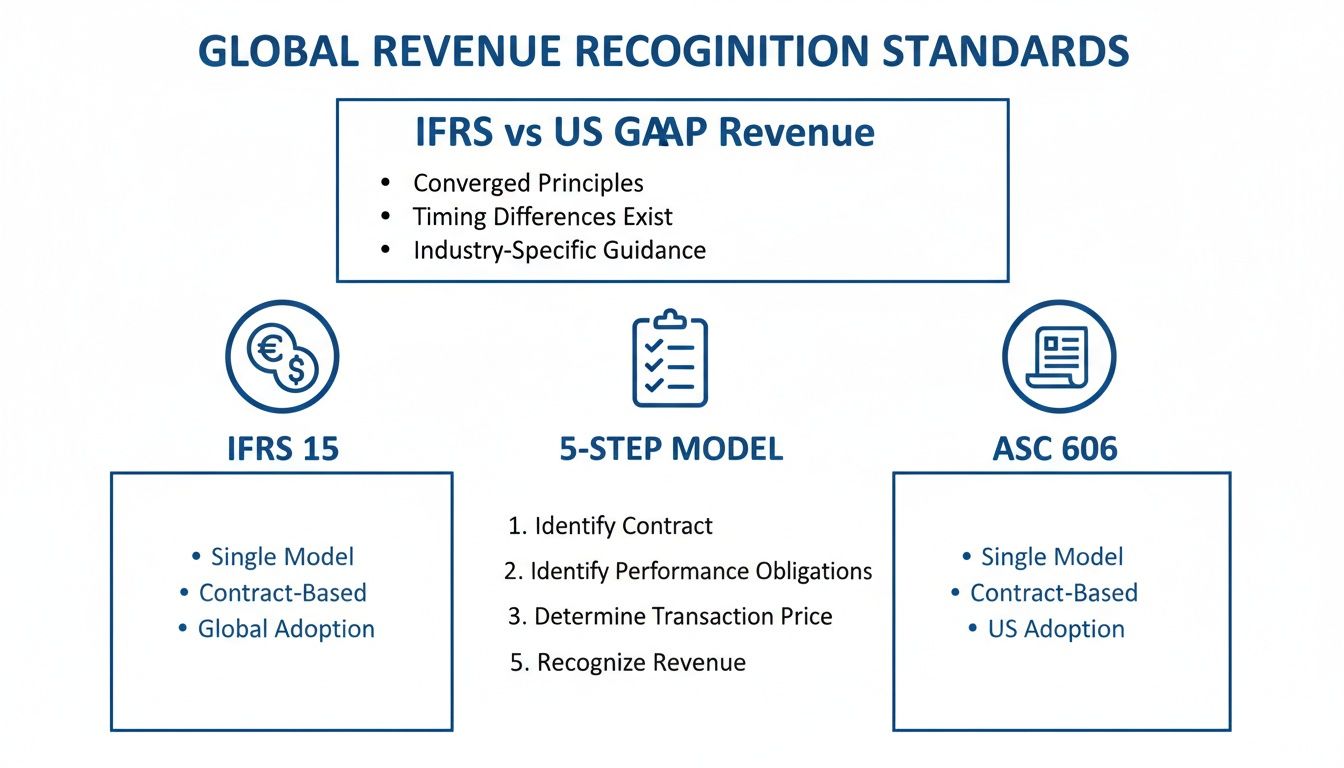
While the five-step revenue model shown above (IFRS 15 and ASC 606) is now aligned, the lease standards prove that core philosophical divides between the two frameworks are still very much alive.
Impairment: The Critical Reversal Rule
Impairment is another area where a simple philosophical difference leads to completely different numbers. The question is straightforward: if you write down an asset's value, can you write it back up if the value recovers?
IFRS uses a more dynamic, one-step model. If an asset’s carrying value is more than its recoverable amount, you book an impairment loss. Crucially, if the asset’s value bounces back later, IFRS allows you to reverse that impairment loss (though this doesn't apply to goodwill).
US GAAP is much stricter. It uses a two-step test for most assets, but the real kicker is this: once an impairment loss is recorded, it can never be reversed. Even if the asset’s market value skyrockets, the write-down is permanent. This "once impaired, always impaired" approach can result in a balance sheet that dramatically understates an asset's true worth.
For an analyst, this means a company under US GAAP could have significant "hidden" value on its books compared to an IFRS competitor. If you want to dive deeper into how these write-downs are handled in group accounts, check out our guide on what is consolidation in accounting.
Nailing these concepts is how you achieve exam success. This is where having a mentor like Mr. Padmanaban, with over 30+ years of experience, becomes a game-changer. He personally mentors every course and walks you through these complex scenarios so you're ready for anything the exam throws at you. The Stride Edutech Mobile App backs this up with 4000+ MCQs and 1500+ solved problems, a tool that has helped our 10,000+ successful students master these topics in a flexible “Study Anytime/Anywhere” ecosystem.
Bottom-Line Impact: How IFRS vs US GAAP Affects Profit
At the end of the day, every technical accounting rule we've discussed boils down to one thing: the bottom line. The choice between IFRS and US GAAP isn’t just some theoretical exercise for accountants. It directly hits a company's reported profit, its earnings per share, and ultimately, its stock price. Getting a handle on these bottom-line impacts is what separates rote learning from true concept clarity—and it's a game-changer for exam success.

These differences explain why two identical companies can look wildly different on paper. For working professionals in India and the Gulf who juggle global reporting, knowing how to reconcile these numbers isn't just a good skill to have; it's non-negotiable.
Development Costs: A Stark Contrast in Profitability
One of the most glaring ifrs vs us gaap differences that can skew profitability is how internal development costs are treated. This single rule can create huge distortions when you’re comparing a tech or pharma company under IFRS to one using US GAAP.
- IFRS (IAS 38): The rule here is more flexible. IFRS allows companies to capitalise certain development costs. If a project is technically feasible, intended for sale, and will generate future cash, its costs can be moved from the income statement to the balance sheet. The immediate effect? Higher reported profit.
- US GAAP: This framework is much stricter. It demands that you expense almost all research and development costs as you incur them. Only a few specific items, like certain software development costs, escape this rule. This approach crushes short-term profit, especially during a company's high-growth phase.
What does this mean in the real world? An innovative company reporting under US GAAP could look far less profitable than its IFRS counterpart, even if their operations and cash flows are exactly the same. For any analyst, this is a major red flag that requires a significant adjustment to make a fair comparison.
"Understanding these bottom-line impacts is where theory meets reality. It’s the difference between passing an exam and excelling as a finance leader. This practical wisdom is what I aim to impart to every student." – Mr. Padmanaban, Chief Tutor
With over 30+ years of experience, our founder Mr. Padmanaban, personally mentors every course at Stride Edutech. He ensures you grasp not just the rules, but their real-world consequences—a philosophy that has guided over 10,000+ students to success.
How Standards Skew Reported Earnings in Practice
India’s financial reporting landscape saw this play out in real-time when major companies started listing on international exchanges. A deep dive into the net profit of leading Indian IT firms showed just how different the numbers could be. For Satyam Computer Services in 2006-07, US GAAP reported the lowest net profit at Rs. 1,344.58 crores—about 4.5% less than the Rs. 1,404.74 crores reported under Indian GAAP. These gaps proved that US GAAP's stricter rules often lead to more conservative, and lower, profit figures. You can explore the full findings from the detailed profit analysis of these Indian IT firms.
This story drives home a critical lesson for any aspiring professional: the accounting framework is a massive variable in your analysis.
For our students in the UAE, Saudi Arabia, and across the Gulf, we know that balancing a job with studies is tough. That’s exactly why our “Study Anytime/Anywhere” ecosystem is so important. Our Mobile App delivers daily class recordings, so you can master difficult topics like consolidation and OCI whenever it fits your schedule. With 300+ lecture hours, 4000+ MCQs, and 1500+ solved problems right on the app, you have every tool you need for exam success in your pocket.
Why Stride Edutech is Your Partner for IFRS & US GAAP Mastery
Understanding the complex differences between IFRS vs US GAAP isn’t just an academic hurdle. For finance professionals in India and the Middle East, it’s a critical career milestone. But true mastery, the kind that leads to exam success and professional confidence, doesn't come from just memorising rules. It comes from deep concept clarity—understanding the ‘why’ behind every standard.
This is where simple textbook learning falls short. You need mentorship that bridges the gap between theory and the real-world problems you’ll face. That’s the core philosophy at Stride Edutech.
Get Founder-Led Expertise on Your Side
We believe that world-class finance education has to be personal and consistent. That’s why our Chief Tutor, Mr. Padmanaban, personally mentors every single student in every course. With over 30+ years of industry experience, he doesn't just teach the standards; he decodes them, turning dense principles into practical, actionable knowledge.
His direct involvement means you get guidance from a seasoned expert who has already helped over 10,000+ students reach their career goals. This isn't a faceless online course; it's a direct mentorship commitment to your success.
"True learning happens when you can apply a concept to a real-world problem. Our goal is to equip you with the judgement and clarity to excel not just in exams, but in your career for decades to come."
This hands-on approach is vital for mastering diverse accounting standards. For those looking to build this level of expertise, our comprehensive IFRS course provides the structured guidance needed.
Learn on Your Terms with Our "Study Anytime/Anywhere" Platform
We get it. Balancing a job with studies, family life, and rigorous exam preparation can feel impossible, especially for professionals in India and the Gulf. That's why we built our "Study Anytime/Anywhere" ecosystem around the powerful Stride Edutech Mobile App.
This isn't just an add-on; it's your lifeline to flexible learning. We upload daily class recordings straight to the app, so you never have to miss a lecture. Whether you're in Dubai, Riyadh, or Mumbai, you can watch lectures at your convenience, no matter the time zone or your work shift.
Our Mobile App, free for all enrolled students, is a complete study partner packed with:
- 300+ lecture hours covering every topic you need, in detail.
- 4000+ MCQs to drill down on concepts and get you exam-ready.
- 1500+ solved problems that walk you through complex scenarios, step-by-step.
Join thousands of successful professionals who have used our proven formula to conquer their exams. With Stride Edutech, you don’t just gain knowledge—you build the confidence that only comes from absolute concept clarity.
Your Top IFRS vs US GAAP Questions, Answered
As you get deeper into global accounting standards, questions are bound to pop up. We’ve gathered the most common queries from students and professionals just like you, providing direct answers to give you the clarity you need to ace your exams and accelerate your career.
Which Is Better: IFRS or US GAAP?
Honestly, neither standard is inherently ‘better’ than the other. The right one simply depends on the context. IFRS is the global language of business, spoken in over 140 countries, making it indispensable for any multinational corporation that needs broad comparability.
On the other hand, US GAAP is the gold standard for the world's largest and most powerful capital market. For any professional, especially in India and the Gulf, with ambitions for a truly global career, mastering the IFRS vs US GAAP differences is far more valuable than picking a side.
How Can I Possibly Balance CMA USA Studies with a Full-Time Job?
This is the number one challenge we hear from working professionals across India and the Middle East. It’s also the exact reason we designed our “Study Anytime/Anywhere” ecosystem. It’s built for the reality of your busy life, addressing the need for balancing a job with studies.
The Stride Edutech Mobile App puts daily class recordings right in your pocket, giving you total control over your study schedule. Whether you’re reviewing a lecture after a long shift in Dubai or listening during your commute in Mumbai, this flexibility is what helps you keep the momentum going without sacrificing your job or personal life.
“Success isn’t about finding more time; it’s about making your study time more effective. Our platform gives you that power.” – Mr. Padmanaban, Chief Tutor
With 30+ years of experience, our founder Mr. Padmanaban personally mentors every course, ensuring each of our 10,000+ successful students gets his direct, expert guidance.
How Do These Differences Actually Impact My Work as a Financial Analyst?
For a financial analyst, understanding these differences is absolutely non-negotiable. You can’t perform an accurate valuation or credible analysis without it. You simply cannot compare two companies at face value if one reports under IFRS and the other under US GAAP.
To create a true like-for-like comparison, you must make specific, informed adjustments to their financial statements. This isn’t just theory; it’s a daily part of the job. You might need to:
- Adjust for capitalised development costs under IFRS.
- Reconcile the different approaches to lease accounting.
- Normalise for the impact of LIFO vs. FIFO inventory valuation.
Mastering this skill is what separates a good analyst from a great one. It makes your insights more reliable, your valuations more defensible, and your work more valuable. The 4000+ MCQs and 1500+ solved problems in our Mobile App are designed to build exactly this practical skill.
Ready to gain the concept clarity that leads to exam success? Join the thousands of professionals who have advanced their careers with Stride Edutech. Explore our courses and see how our founder-led expert mentorship and flexible learning platform can help you achieve your goals. Learn more at strideedutech.com.